



The Most Common Hair Loss Condition Nobody Talks About
Female pattern baldness, medically termed female pattern hair loss (FPHL) or androgenetic alopecia, is the most common cause of hair loss in women. It affects approximately one-third of susceptible women across their lifetimes, with prevalence increasing significantly after menopause.
Unlike male pattern baldness, which produces a distinctive receding hairline, female pattern baldness typically presents as diffuse thinning at the crown and a widening center part. The frontal hairline usually remains intact. Many women do not recognize it as pattern loss and instead attribute the change to stress, diet, or aging without seeking appropriate evaluation.
What Causes It
The condition is driven by a combination of genetic predisposition and androgen sensitivity. Women produce androgens, including testosterone and its more potent derivative DHT (dihydrotestosterone), as a normal part of hormone balance. In women with genetic sensitivity to these hormones at the follicle level, DHT triggers follicular miniaturization: the follicle progressively shrinks over repeated cycles, producing thinner and shorter hairs until growth ceases entirely.
Hormonal triggers including the estrogen decline of perimenopause and menopause, stopping hormonal birth control, postpartum hormone shifts, and elevated androgens in PCOS can all accelerate the process in genetically susceptible women.
The Stages of Female Pattern Hair Loss
The Ludwig Scale has three stages:
Stage I: Mild thinning at the crown and part line, easily concealed with styling
Stage II: Noticeable widening of the part with visible scalp at the crown
Stage III: Diffuse thinning across the top of the scalp with significant visible scalp
Treatment is most effective when started early. Once follicles reach advanced miniaturization, they may become permanently inactive.
What the Evidence Supports
The only FDA-approved topical treatment for female pattern hair loss is minoxidil 2% or 5%. Low-dose oral minoxidil is increasingly used off-label. Spironolactone is frequently prescribed for women with elevated androgens. These are physician conversations.
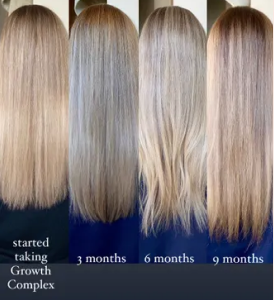
Nutritional support addresses the deficiency layer that amplifies androgenetic alopecia in many women. Zinc, selenium, ferritin, vitamin D, and biotin deficiencies are all consistently more common in women with pattern loss. HAIRLOVE Growth Complex provides Cynatine HNS, Biotin, Zinc, and Selenium to remove the nutritional burden from follicles already under androgenic stress.
The hair growth serum with GHK-Cu (Copper Tripeptide-1) addresses the topical side: improving follicle circulation, extending the anagen phase, and supporting the scalp environment in which remaining follicles operate.


