


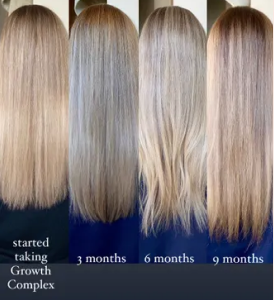


If you've been finding more hair than usual in the shower or on your pillow, the first useful question is: is this hair loss or hair shedding? They look similar in the short term, but they're different processes with different causes and different timelines.
Getting this distinction right changes the approach. Shedding responds well to nutritional and lifestyle interventions. Permanent hair loss often requires hormonal or medical treatment alongside nutritional support. The Growth Complex is designed to address the nutritional drivers that contribute to both, but knowing which one you're dealing with helps set realistic expectations.
The Biological Difference
Hair shedding is a normal, cyclical process. Every hair follicle cycles through anagen (growth), catagen (transition), and telogen (rest/shedding). During telogen, the hair sits in the follicle for roughly 3 months, then sheds as the follicle prepares for a new growth cycle. Losing 50 to 100 hairs per day is completely normal, those are telogen hairs completing their natural cycle.
Excessive shedding (medically called telogen effluvium) occurs when a larger-than-normal proportion of follicles simultaneously enter the telogen phase. This produces a noticeable increase in shedding, often 200 to 400+ hairs per day in acute cases, typically triggered by a physiological stressor: illness, surgery, significant caloric restriction, childbirth, hormonal shifts, or severe emotional stress.
Hair loss involves follicle-level damage or miniaturization. The follicle itself is affected, not just the cycling timing. Androgenic alopecia (the most common form of hair loss in women) occurs when DHT progressively shrinks follicles over time, producing finer and shorter hairs with each cycle until they may stop producing hair entirely. Autoimmune conditions like alopecia areata involve the immune system attacking follicles directly.
How to Tell Which One You Have
Pattern of loss. Telogen effluvium typically causes diffuse, even shedding across the entire scalp, with no specific areas affected more than others. Androgenic alopecia tends to affect the crown and top of the scalp most prominently in women, with widening of the part line. Alopecia areata produces circular patches of bare scalp.
Rate of change. Shedding episodes often have a sudden onset, you notice it starting within a few weeks. Androgenic hair loss is gradual, often taking months or years before it becomes visually obvious.
Timing relationship to stressors. Think back 2 to 4 months before the shedding started. Did something significant happen: illness, extreme stress, major dietary change, childbirth, thyroid diagnosis, new medication? The 2 to 4 month lag between trigger and shedding is characteristic of telogen effluvium.
Hair regrowth at the scalp. With telogen effluvium, new short hairs growing back in at the scalp surface are a good sign, the follicles are active and cycling. With androgenic alopecia, the new hairs may be finer and shorter than the ones that shed, reflecting follicle miniaturization.
Pull test. Gently grip 20 to 30 hairs near the root and pull. More than 6 hairs coming out suggests active shedding. This is a rough indicator, a dermatologist can perform a formal trichoscopy or pull test.
Telogen Effluvium: What Resolves It
Because telogen effluvium is triggered by a physiological stressor, the primary treatment is removing or resolving the trigger. Once the trigger is gone, the hair cycle normalizes on its own, usually within 3 to 6 months of the original event.
What accelerates recovery:
Correcting nutritional deficiencies (iron, zinc, protein, vitamin D) that may prolong the shedding phase.
Reducing ongoing physiological stress.
Supporting follicle health nutritionally.
Understanding the telogen effluvium mechanism in detail provides the biological context for why this timeline is what it is, and why shedding can paradoxically increase briefly as recovery begins.
Androgenic Hair Loss: A Different Approach
Androgenic alopecia requires a different approach because the mechanism is different. The nutritional layer still matters (zinc and selenium in particular have documented relationships with androgen metabolism), but the primary driver is hormonal, and addressing it often requires medical intervention alongside nutritional support.
For women, options include topical minoxidil, anti-androgen medications (spironolactone, finasteride at specific doses), and hormonal approaches including certain oral contraceptives. These are conversations with a dermatologist or OB-GYN, not a supplement decision.
What nutritional support does for androgenic alopecia: it removes the factors that amplify the loss. A woman with androgenic hair loss and zinc deficiency will lose hair faster than one without the deficiency. Correcting the deficiency doesn't reverse the androgenic process, but it reduces how severe the manifestation is.
When to See a Dermatologist
Regardless of which type you think you have, a dermatologist or trichologist is worth consulting if:
- Shedding is severe (more than 200 hairs per day for more than 3 months).
- You're seeing bare patches or significant scaling.
- Standard interventions (correcting deficiencies, managing stress) aren't producing improvement.
- You can't identify a trigger for a shedding episode.
For the broader hormonal context, how estrogen, DHT, and thyroid hormones all interact with hair cycling, the full hormone and hair loss picture is a useful reference.
Knowing Which Type You Have Changes Everything
Hair shedding and hair loss are different processes that look similar in the short term but have different causes, different timelines, and different solutions. Telogen effluvium, excessive but temporary shedding, is usually addressable with nutritional support and time. Androgenic hair loss is hormonal and progressive, and it requires a different approach. Getting this distinction right is the most important first step.
Frequently Asked Questions
Is it normal to lose 200 hairs a day?
Normal daily hair shedding is 50 to 100 hairs. Losing 150 to 200+ consistently over several weeks suggests telogen effluvium, more follicles than usual are simultaneously in the resting/shedding phase. It's not dangerous in itself, and it's usually temporary, but it warrants investigation for a triggering cause: a stressor 2 to 4 months earlier, nutritional deficiency, thyroid dysfunction, or significant hormonal change.
Does hair shedding from telogen effluvium grow back?
Yes, in the vast majority of cases. Telogen effluvium doesn't damage follicles, it accelerates their cycling. Once the trigger is removed and nutritional status is supported, the follicles return to a normal staggered cycle. Most people see regrowth beginning within 3 to 6 months of the triggering event, with full density restored by 9 to 12 months. If shedding persists beyond 6 months without improvement, evaluation by a dermatologist is appropriate.
What's the difference between hair shedding and a receding hairline?
Shedding is a temporary increase in all-over hair loss across the scalp. A receding hairline is a patterned change, specifically the regression of the hairline at the temples or frontal scalp, that indicates androgenic alopecia rather than diffuse shedding. They can occur together (someone can have both female pattern hair loss and a stress-triggered telogen effluvium episode), which is why the distinction isn't always clean.
Can stress cause permanent hair loss?
Stress-triggered shedding (telogen effluvium) is almost always temporary, the follicles are not permanently damaged. However, chronic, severe, or repeated stress episodes can create a pattern of recurring shedding that feels permanent. Additionally, stress elevates cortisol, which may accelerate progression of underlying androgenic hair loss in genetically susceptible individuals. Managing chronic stress is a real intervention for hair health, not just a generic wellness recommendation.
Sources
American Academy of Dermatology (hair shedding norms); NIH/PubMed Central (telogen effluvium mechanism); Cleveland Clinic.


