


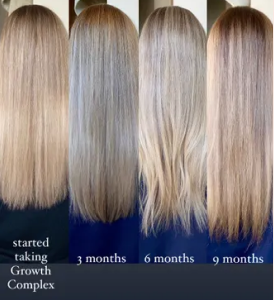


One of the most common reasons people give up on hair supplements is that they stop too early. Not because the supplement isn't working — because they expected results in 4 weeks when the biology requires 90 days minimum.
This isn't a supplement problem. It's a hair biology problem. Understanding how the hair cycle actually works makes the timeline make sense — and helps you stay consistent long enough to see results.
If you're taking the Growth Complex or evaluating whether to start, here's what to expect, and when.
The Hair Growth Cycle: Why Timing Matters
Each hair follicle operates on its own independent cycle:
- Anagen (growth): Active growth phase. Lasts 2–7 years. The longer the anagen phase, the longer the hair can grow.
- Catagen (transition): Brief phase (~2–3 weeks) where growth stops and the follicle begins to shrink.
- Telogen (resting/shedding): The follicle rests for ~3 months before the hair sheds and the cycle restarts.
At any given time, roughly 85–90% of your scalp hairs are in anagen, 10–15% are in telogen. Normal daily shedding (50–100 hairs) reflects telogen hairs completing their cycle.
Supplements influence the hair cycle — they don't override it. When you take a supplement that effectively extends anagen, reduces premature telogen entry, or supports follicle health, those effects take 1–2 full cycle phases to become visible. That's just how hair biology works.
The Realistic Week-by-Week Breakdown
Weeks 1–4: Nothing Visible Yet
This is the phase where most people get discouraged. There's no visible change in shedding or density during this phase — but that's not evidence the supplement isn't working. The active ingredients are being incorporated, nutritional deficiencies are beginning to correct, and follicle-level changes may be underway. You just can't see them yet.
Weeks 5–8: Shedding May Reduce
For many people, the first sign is a reduction in shedding — less hair in the shower drain, less on the brush. This is meaningful. Fewer hairs entering telogen early means more staying in the active growth phase. It's a leading indicator of what will become visible density improvement.
Some people experience a brief increase in shedding during this phase. This is usually a sign that follicles previously stuck in a prolonged telogen phase are resetting and beginning new growth cycles. It's temporary and resolves.
Weeks 9–12: First Visible Changes
Around the 3-month mark, most consistent users begin to notice some visible change — new short hairs along the hairline, improved texture, or noticeably less shedding in the brush. This is when clinical studies typically show their first statistically significant results.
The first 90 days on Growth Complex covers this window in detail, including what changes to look for and how to assess whether it's working.
Months 4–6: Meaningful Density Improvement
This is when the changes become undeniable for most people. Hair that started growing after the supplement was incorporated has now had 3+ months to grow and is becoming visible at length. Density improvement is typically most noticeable at the crown and temples for those experiencing diffuse thinning.
Months 6–12: Full Effect
For those with longer-standing hair loss, the full effect of consistent supplementation may take closer to 6–12 months to manifest. New follicles completing full growth cycles, increased strand diameter, and improved overall density all compound over time.
Why Most Products Fail to Show Results
A few reasons hair supplements genuinely don't work for some people:
The root cause isn't nutritional. Supplements address the nutritional and physiological factors that contribute to hair loss. If hair loss is being driven by an untreated thyroid condition, a hormonal disorder, or autoimmune alopecia areata, nutritional supplementation alone won't reverse it.
The dose is too low. Many supplements contain ingredients at sub-therapeutic doses — enough to put them on the label, not enough to have a clinical effect.
The timeline is too short. Three weeks is not a sufficient trial. Three months is the minimum. Six months gives a full picture.
Consistency was lacking. Hair supplements require daily intake. Missing doses during the week undermines the consistent nutritional environment follicles need.
How to Track Progress Honestly
A few approaches that work better than mirror-checking every morning:
Baseline photo. Take a well-lit photo of your part line and crown on Day 1, in the same lighting and position. Repeat at 30, 60, and 90 days. Changes that are invisible day-to-day become obvious in comparison photos.
Brush count. For a week before starting, count the hairs in your brush after each session. Repeat at weeks 4, 8, and 12. A reduction in brush count is typically the earliest measurable signal.
Daily supplement tracking. Use a habit tracker or calendar. Knowing your actual compliance gives you honest data about whether the "it's not working" feeling is accurate.
For a broader look at how the hair science works at the follicle level — including why the cycle phases are timed the way they are — that post provides the biological foundation.
Staying Consistent Long Enough to See the Results
Hair growth supplements that work take 90–180 days to produce visible results. That's a hair biology reality, not a product limitation. The three-month mark is the first meaningful evaluation point; six months gives the complete picture. Stopping at week four because nothing looks different isn't a fair test — it's just too early. Track your progress with photos, note shedding changes, and let the biology do what biology does at biology's pace.
Frequently Asked Questions
Q: Why am I shedding more after starting a hair supplement?
A temporary increase in shedding after starting supplementation is actually a recognized phenomenon — follicles that were stuck in a prolonged resting phase begin cycling again when nutritional status improves, and they all shed their resting hairs before starting new growth. This typically lasts 2–4 weeks and is followed by a reduction in shedding. If shedding is severe or persists beyond 6 weeks, consult a dermatologist.
Q: Should I take hair supplements with food?
Yes — most hair supplement ingredients are fat-soluble vitamins or minerals that absorb significantly better when taken with a meal that contains some fat. Zinc on an empty stomach can cause nausea in some people. Taking Growth Complex with breakfast is ideal: food improves absorption, the habit ties to an existing routine, and morning is a consistent time that's easier to maintain.
Q: What if I miss a dose — does that reset my progress?
Missing an occasional dose doesn't reset anything. Nutritional supplementation works by maintaining elevated tissue levels of key nutrients over time — one missed day doesn't deplete that. What matters is the overall pattern. If you're consistently missing 2–3 days per week, that undermines the effect. Don't double up after missing a dose; just resume your regular schedule.
Q: How do I know if a hair supplement is working?
The most reliable early indicator is a reduction in the hair count from your brush or shower drain — track this specifically in weeks 4–8. Visible density changes come later, typically at the 3-month mark. Comparison photos in the same lighting at the crown and part line give you honest data that's impossible to assess from daily mirror checks, where changes accumulate too slowly to notice in real time.


