



If you are looking for the GH peptide with the weakest case for causing hair loss, ipamorelin is it. Its reputation for a clean side-effect profile relative to other secretagogues is backed by the pharmacology. Here is what the evidence shows.
What Ipamorelin Is
Ipamorelin is a selective ghrelin mimetic and pentapeptide GH secretagogue. Raun et al. characterized it in 1998 as the first selective growth hormone secretagogue, meaning it stimulates GH release with minimal activation of other pituitary pathways. In particular, it does not significantly stimulate cortisol, prolactin, or aldosterone at doses that produce GH release.
That selectivity is the foundation of its "clean" reputation.
The Hormonal Case for Shedding Is Weakest Here
The proposed hormonal routes to GH peptide hair loss run through cortisol, prolactin, and indirect DHT. Ipamorelin, by design and by the clinical evidence, produces minimal collateral hormone elevation:
- Cortisol: significantly less elevation than GHRH or GH itself at comparable GH-stimulating doses (established in Raun et al.)
- Prolactin: minimal response compared to non-selective GH secretagogues
- Aldosterone: minimal response
- IGF-1: does rise, as expected from GH stimulation, and IGF-1 is pro-hair
A pharmacokinetic-pharmacodynamic study by Gobburu et al. confirmed ipamorelin's clean GH-stimulating profile in human volunteers. The hormonal case for ipamorelin-driven shedding is the weakest in this class of compounds.
The Remaining Route: Diet and Fat Loss
With the hormonal pathways largely closed, if shedding occurs during ipamorelin use, the most likely explanation is the recomp context, not the compound itself. Significant fat loss triggers telogen effluvium through the physiological stress mechanism independent of any peptide. If ipamorelin is being used alongside aggressive caloric restriction and fat loss is rapid, shedding two to three months into the program is telogen effluvium from that fat loss, not from the peptide's hormonal action.
The Stacking Note: Usually Paired With CJC-1295
Ipamorelin is most commonly used in a stack with CJC-1295, which provides the sustained GHRH-analog action while ipamorelin provides the ghrelin-receptor pulse. The combined stack has a different profile than ipamorelin alone. If shedding occurs on this stack, attribution to one compound over the other is not straightforward. The CJC-1295 spoke covers that compound's contribution. For the full shared mechanism picture, see the GH peptides hub.
Predisposition Gate and Temporary vs Permanent
The same logic applies across all GH compounds: androgenetic miniaturization only occurs in people with the inherited follicle sensitivity to DHT. Telogen effluvium from fat loss is temporary in virtually all cases.
Supporting Hair Through a Recomp Phase
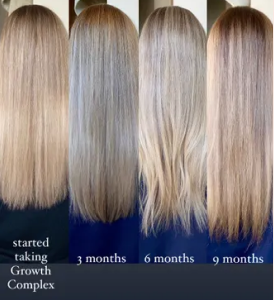
For users who experience shedding in the context of ipamorelin use, nutritional support is the primary lever. Women's Growth Complex provides Cynatine HNS, zinc, and selenium to support the follicle environment during a calorie-restricted recomp phase. The microfiber towel reduces friction-induced breakage on fragile shedding hair. Support through the shed, not prevention.
It is also worth noting that ipamorelin is generally dosed lower and with less aggressive dietary restriction than MK-677 protocols, which are often run at higher IGF-1 targets. The user profile matters. Someone using ipamorelin for recovery optimization at moderate doses and eating at or near maintenance may be at very low risk for any form of shedding. Someone stacking it with CJC-1295 and running a 700-calorie daily deficit is exposed to significant fat-loss telogen effluvium risk regardless of which compound they pick.
The practical takeaway is that ipamorelin's clean hormonal profile reduces the hormonally-driven shedding risk but does not eliminate the fat-loss-driven shedding risk. The diet variable is the primary lever for anyone concerned about hair on this compound.
Practical Guidance for the Ipamorelin User Concerned About Hair
Monitor the rate of fat loss rather than just the total. If weight is dropping faster than 1 to 1.5 lbs per week, telogen effluvium risk increases substantially regardless of which compound you are using. A slower recomp with better nutritional compliance produces the same body composition results with a meaningfully smaller hair cost.
Track ferritin every eight to twelve weeks during an active cut. Ferritin is the most sensitive early indicator of iron-store depletion, and it depletes faster than hemoglobin, meaning you can be functionally iron-deficient for hair purposes while your complete blood count looks normal. A ferritin drop below 30 mcg/L signals a deficit that warrants dietary adjustment and potentially supplementation.
Keep protein intake high throughout the cut. Hair is keratin. The daily protein target during any active cut should be at minimum 1.6g per kg of body weight, reflecting elevated requirements in a body that is simultaneously losing fat, preserving muscle, and maintaining active hair follicle cycling. This is higher than standard maintenance recommendations and reflects the specific demands of a body recomposition protocol.


