


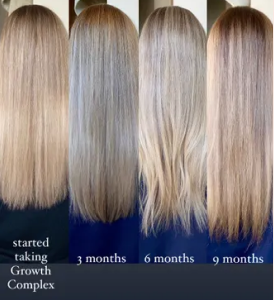

Copper peptides have been a staple of serious skincare for decades. Now they're appearing in hair and scalp care, and for good reason — the research that established their role in skin regeneration has a direct parallel in hair follicle biology. This is a trend backed by a genuine mechanism.
The HAIRLOVE Scalp Serum is formulated around GHK-Cu — the copper peptide with the most established research record. Here's what it is, how it works, and what evidence supports using it for hair growth.
What Copper Peptides Are
Copper peptides are naturally occurring small proteins — tripeptides — in which a copper ion is bound to an amino acid sequence. The specific compound GHK-Cu (glycine-histidine-lysine copper) was first isolated from human plasma in the 1970s by biochemist Loren Pickart, who found that it had regenerative properties on aging tissue.
GHK-Cu is present naturally in blood plasma, saliva, and urine, and its concentration decreases with age. The topical application of copper peptides delivers it to tissue where endogenous levels have declined.
What GHK-Cu Does at the Follicle Level
The research on GHK-Cu and hair growth covers several distinct mechanisms:
Anagen phase extension. Laboratory studies have shown that GHK-Cu can increase the size of hair follicles and extend the anagen (active growth) phase (Pickart & Margolina, 2018 review; Pyo et al. 2012). Larger follicles produce thicker hair shafts; a longer anagen phase means more time growing before the follicle rests and sheds.
Follicle stem cell stimulation. Hair follicles contain stem cells that are responsible for cycling — initiating new growth after each resting phase. GHK-Cu has been shown to stimulate these stem cells, potentially improving the follicle's ability to re-enter and sustain active growth.
Extracellular matrix support. The extracellular matrix — the structural scaffolding of proteins and collagen that surrounds follicles — is critical for healthy cycling. GHK-Cu supports the synthesis of collagen, elastin, and glycosaminoglycans that make up this matrix. In aging scalp tissue, where the matrix naturally degrades, this is particularly relevant.
Anti-inflammatory activity. Chronic low-grade scalp inflammation contributes to follicular miniaturization and premature shedding. GHK-Cu has documented anti-inflammatory properties that may reduce this follicle-level inflammation.
Potential DHT modulation. Some research suggests copper peptides may help counteract the effects of DHT on susceptible follicles, though this mechanism is less established than the others and is described as an area of ongoing research rather than a confirmed effect.
Copper Peptides vs. Other Trending Hair Growth Ingredients
A useful comparison with some of the other ingredients currently appearing in scalp serums:
vs. Minoxidil. Minoxidil (Rogaine) is the most clinically established topical treatment for androgenic alopecia. Its primary mechanism is vasodilation — increasing blood supply to follicles. Copper peptides work through a different pathway (follicle biology and matrix support) and are not directly comparable in mechanism or evidence level. They complement rather than replace minoxidil for those using it.
vs. Rosemary oil. Rosemary oil has received attention following a 2015 randomized trial comparing it favorably to 2% minoxidil, opens in a new tab (Panahi et al., Skinmed). The mechanism is similar to minoxidil (improved scalp circulation). Copper peptides work differently and are arguably better characterized in the literature.
vs. Biotin (topical). Topical biotin is a popular inclusion in scalp serums with limited direct evidence for topical (vs. oral) application. Copper peptides have more robust direct evidence for follicle-level activity.
vs. Caffeine. Topical caffeine has evidence for DHT antagonism at the follicle level, opens in a new tab, opens in a new tab (Fischer et al., Br J Dermatol, 2014). Copper peptides and caffeine work through complementary mechanisms and are often combined in well-formulated serums.
How to Use Copper Peptides Effectively
A few practical points for getting the most from copper peptide scalp treatments:
Apply to clean scalp. Copper peptides need contact with the scalp surface to absorb. Application after washing, to a slightly damp scalp, optimizes delivery.
Avoid combining with high-pH products. Copper peptides are most stable at slightly acidic to neutral pH. Mixing them directly with alkaline products can reduce their activity. Apply separately from anything with a high pH (like some scalp treatments).
Consistency over time. The studies showing follicle effects used regular daily or twice-daily application over weeks to months. This isn't an ingredient with visible effects after a few uses.
Support internally. Topical copper peptide application works best alongside nutritional support. The follicle-level changes a serum initiates require the raw materials (protein, micronutrients) to be present internally. Signs your scalp environment may need broader support is a useful reference.
The Evidence Summary
The research base for GHK-Cu in hair growth is stronger than most trending ingredients in this space, but it's still mostly laboratory, in-vitro, and small-scale clinical research. Large-scale randomized controlled trials specific to hair growth are limited. This isn't a reason to dismiss it — many effective topical ingredients have similar evidence profiles — but it is a reason to be realistic about claims.
What the evidence supports: copper peptides may extend the anagen phase, support follicle stem cell activity, improve the scalp's structural environment, and reduce follicle-level inflammation. These are meaningful, mechanistically plausible effects that make copper peptides a sensible inclusion in a serious scalp serum.
For the broader picture on building an effective scalp care approach — and how topical serums fit into it — a complete scalp care routine provides the practical framework.
Adding Copper Peptides to Your Routine: What to Expect
Copper peptides for hair growth are backed by real biology — GHK-Cu targets follicle health through several complementary mechanisms with better research support than most trending scalp ingredients. Applied consistently to a clean scalp, as part of a broader hair health approach that includes internal nutritional support, it's one of the more evidence-informed topical options available. The effect builds over weeks and months, not days.
Frequently Asked Questions
Q: Do copper peptides actually regrow hair?
The more accurate framing is that copper peptides support the conditions for hair to grow by extending the anagen phase, stimulating follicle stem cells, and improving the scalp's structural environment. In follicles that are still active but underperforming, this can translate to visible improvements in density and strand quality over time. For follicles that are permanently dormant, no topical ingredient reliably restores function.
Q: How long do copper peptides take to work on hair?
The published research on GHK-Cu in skin uses application periods of 4–12 weeks to demonstrate measurable effects. For hair, where the cycle is longer, expect a minimum of 8–12 weeks before assessing any topical result. Many users report noticeable texture and reduced shedding improvements around weeks 6–8, with density changes following at 3–4 months of consistent use.
Q: Can I use copper peptides with other scalp treatments?
Generally yes, with one caveat: avoid combining copper peptides directly with high-strength vitamin C serums or very low-pH acids in the same application. Copper can react with certain compounds at the wrong pH, reducing the activity of both ingredients. Apply copper peptide serums separately from acidic treatments — different times of day or on alternating days works well.
Q: Are copper peptides safe for all hair types and scalp conditions?
Copper peptides are generally well-tolerated. The main contraindication is active scalp infection, open sores, or severe inflammation — don't apply any active ingredient to compromised skin. For people with sensitive scalps, starting with every-other-day application and building to daily use gives the skin time to adjust. Discontinue and consult a dermatologist if you notice significant irritation.


