



The advice to brush your hair 100 strokes per night for growth has been around long enough that most people have heard it. The research on it is more nuanced than the advice suggests. Here is what brushing actually does and does not do for hair growth.
What Brushing Does Not Do
There is no published clinical trial showing that brushing hair increases hair count or follicle density. The mechanism proposed (scalp stimulation increasing blood flow) has some biological plausibility but has not been tested in a rigorous study specifically for brushing. The 100-stroke rule has no research basis and predates modern hair science by decades.
Excessive brushing, particularly on dry or fragile hair, causes mechanical breakage. Each brushing stroke creates friction on the hair shaft, and over-brushing is a documented cause of hair damage, split ends, and breakage, which gives the appearance of reduced density and length.
What Brushing Actually Does
Distributes natural sebum from the scalp along the hair shaft. Sebum is the scalp's natural conditioning agent, and brushing helps coat dry mid-lengths and ends with it.
Detangles knots and reduces the mechanical stress of combing out tangles by hand, which can cause significant breakage if done on wet hair without the right tool.
Provides mild scalp stimulation. Brushing does stimulate the scalp surface and may provide some of the circulation benefit associated with scalp massage, though at a lower intensity and less consistency than a dedicated scalp massage protocol.
Removes loose telogen-phase hairs that have already shed from the follicle. These would fall out regardless. Brushing simply collects them.
The Case for Scalp Stimulation
The benefit most likely to support hair growth through brushing is the mild scalp stimulation it provides. The Koyama 2016 study showed that consistent, standardized scalp massage produced increased hair shaft diameter after 24 weeks. Brushing provides a lower-intensity version of this stimulation.
For a more targeted and consistent scalp stimulation protocol, the Detox Scalp Massager provides controlled mechanical pressure to the scalp specifically, rather than the mixed shaft-and-scalp stimulation of a hair brush.
How to Brush Without Causing Damage
Brush dry hair only. Wet hair has reduced structural integrity and breaks more easily under mechanical stress. Start at the ends and work up to the roots. This prevents compacting tangles against the scalp and dragging them through more of the hair shaft.
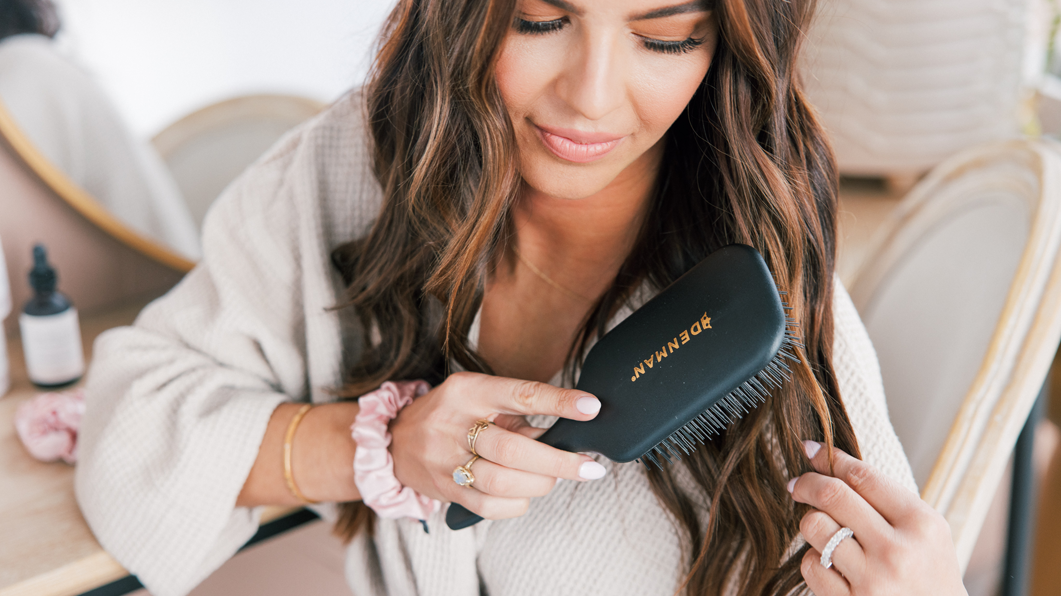
Moderate strokes are better than aggressive brushing. The Denman Hair Brush with its 7-row configuration is designed to smooth the hair without the excessive tension that smaller, denser brushes create. It is particularly suited to fine or thinning hair where breakage risk is higher.
Building a Minimal Effective Brushing Routine
The goal is sufficient brushing to distribute sebum, detangle, and provide mild scalp stimulation, without exceeding the point where additional brushing creates friction damage. For most hair types, that means one thorough brush-out session on dry hair per day, using the right tool and starting from the ends.
For thinning or fragile hair specifically, less is often more. Over-brushing thin hair is a common and avoidable source of daily breakage. Five to ten passes through dry, fully detangled hair is sufficient to achieve sebum distribution and mild scalp stimulation without creating unnecessary shaft stress.
What Brushing Cannot Replace
Brushing is a grooming tool, not a treatment for hair loss. If hair is shedding due to nutritional deficit, hormonal imbalance, or androgenetic alopecia, no amount of brushing will address those causes. The scalp stimulation that brushing provides is a fraction of what a dedicated scalp massage protocol delivers, and the evidence for scalp massage itself is preliminary rather than definitive.
Brushing is worth doing correctly to prevent the additional mechanical damage that over-brushing causes, and it provides the sebum distribution benefit that is genuinely useful for hair shaft condition. But it should be understood as a hygiene and conditioning tool, not a growth intervention.
Combining Brushing With Other Scalp Practices
Brushing is one element of a broader scalp and hair care practice, not a standalone treatment. Combined with regular scalp massage using the Detox Scalp Massager, the scalp stimulation dimension of brushing is amplified. Combined with the right post-shower technique (Luxury Hair Towel, ends-first brushing on dry hair), the mechanical protection function of brushing becomes part of a protective routine rather than a standalone habit.
For people using the Denman Brush as their primary detangling tool, pairing it with the Detox Scalp Massager on wash days covers both the post-wash gentle detangling function and the scalp stimulation and product distribution function. The two tools address different moments in the hair care routine and do not overlap.


