



Hair breakage and hair loss both result in hair appearing in your brush, on your pillow, and in the shower drain. They look similar on a bad hair day. But they are fundamentally different things with different causes and different solutions. Confusing the two leads to spending money and time on the wrong approach.
The One-Test Distinction
The fastest way to tell the difference: pick up a shed hair and look at both ends.
- Natural shed (telogen hair loss): one end has a small white or translucent bulb, the telogen club. This is the root of the hair that has completed its growth cycle and separated from the follicle naturally. The other end, the tip, is tapered and slightly pointed from normal wear.
- Breakage: both ends are relatively blunt and flat. The strand snapped somewhere along its length from mechanical, chemical, or thermal stress. There is no root bulb because the strand was not released from the follicle.
If most of the hairs in your brush have blunt ends: breakage is the primary issue. If most have small bulbs at the root: shedding from the follicle is the primary issue. Many people have both happening simultaneously, which is why it can be confusing.
What Causes Breakage
- Mechanical stress: aggressive towel drying, brushing wet hair with the wrong tool, tight hairstyles, ponytail elastic damage.
- Thermal damage: heat styling at temperatures that exceed the hair shaft's structural tolerance (above 230 degrees Celsius or 450 Fahrenheit for most hair types).
- Chemical damage: bleaching, perming, or relaxing the hair weakens the disulfide bonds in the keratin structure, making the shaft prone to mid-length snapping.
- Environmental stress: sun exposure (UV degrades keratin), hard water mineral deposits, chlorine exposure.
What Causes Hair Loss From the Follicle
- Nutritional deficit: particularly ferritin depletion, protein insufficiency, zinc deficiency.
- Hormonal changes: postpartum estrogen drop, birth control changes, perimenopause, thyroid dysfunction.
- Androgenetic alopecia: genetic follicle sensitivity to DHT causing progressive miniaturization.
- Telogen effluvium: synchronized shedding triggered by stress, illness, surgery, or weight loss.
Tools and Products for Breakage
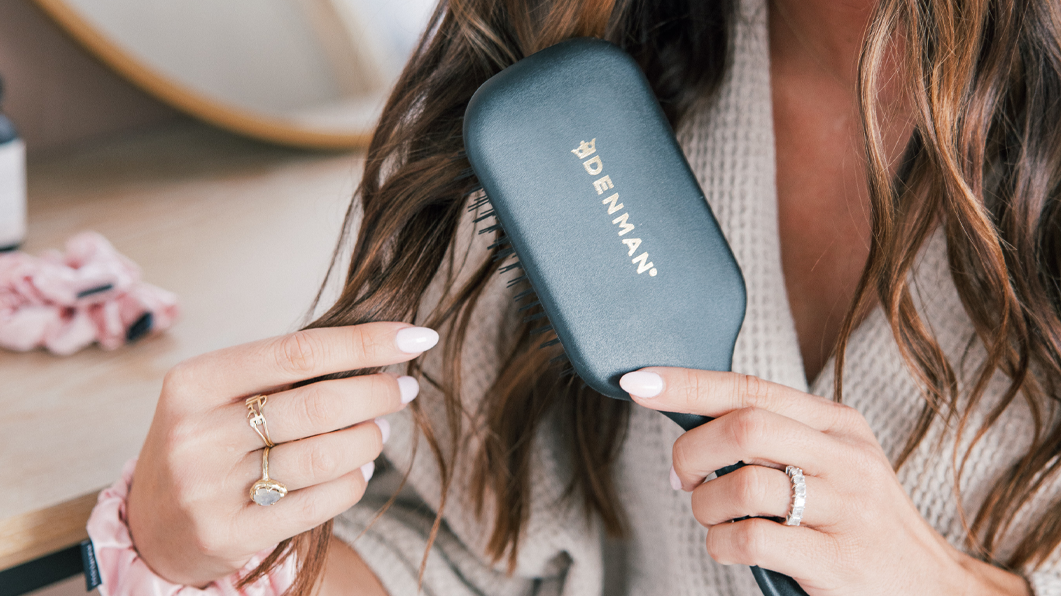
Breakage is addressed by removing the mechanical stressor and protecting the hair shaft from further damage. The Luxury Hair Towel eliminates post-shower friction, the Denman Hair Brush provides controlled detangling with a cushioned base that flexes at tangles rather than pulling through them, and a silk pillowcase eliminates overnight cuticle roughening.
For chemically or thermally damaged hair, leave-in conditioning treatments that restore moisture to the cortex reduce the brittleness that leads to breakage. The HAIRLOVE Nourish + Repair serum addresses the topical conditioning layer for damaged hair.
Tools and Products for Follicle-Level Loss
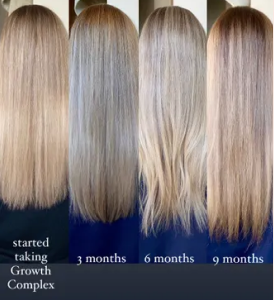
Follicle-level loss requires addressing the internal cause. Growth Complex provides the nutritional inputs (keratin, zinc, selenium, biotin) that support healthy follicle cycling. Medical causes (androgenetic alopecia, thyroid, hormonal) require appropriate treatment alongside nutritional support.
When You Have Both
Both breakage and follicle-level shedding are common simultaneously, particularly for people with thinning hair who are also handling their hair aggressively out of frustration. Addressing both at the same time is the right approach: Growth Complex internally while adopting the protective post-shower and overnight routine externally.
The Combined Approach for Both
For people dealing with both breakage and follicle-level shedding simultaneously, addressing both dimensions at the same time is more effective than addressing one and then the other. The mechanical protection tools (Luxury Hair Towel, Denman Brush technique, silk pillowcase) address the breakage component. Growth Complex addresses the follicle-level nutritional component. These are parallel tracks that do not interfere with each other.
A practical sequence: start Growth Complex and the protective post-shower routine simultaneously. Track shed count from day one. At 90 days, reassess: if shed count has dropped meaningfully (suggesting nutritional response), the supplement is working. If the flat-ended shed hairs have decreased as a proportion of your total daily shed (suggesting less breakage), the protective tools are working. Both improvements can and often do occur together.


