




Walk into any pharmacy or scroll any beauty retailer and you will find rows of products claiming to grow hair. Hair growth pills are a real category with real science behind them, but the gap between what is on the label and what actually works is significant. This post covers what the evidence supports, which ingredients matter, and how to evaluate any supplement honestly.
What Hair Growth Pills Actually Do
Hair growth supplements do not create new follicles or grow hair where none exists. What they can do is support the biological conditions that allow follicles to cycle normally, produce hair shaft protein efficiently, and remain in the active growth phase longer. Hair is almost entirely made of a structural protein called keratin. The follicle that produces it is one of the most metabolically active structures in the body, requiring a consistent supply of amino acids, vitamins, and minerals to do its job. When any of these inputs is insufficient, the hair cycle is disrupted. That disruption shows up as increased shedding, slowed growth, or thinner strands.
A genuine hair growth supplement addresses one or more of these inputs at a meaningful dose. A marketing-driven supplement puts small amounts of popular ingredients into a capsule without delivering enough of anything to move the needle.
Ingredients With Real Evidence
Cynatine HNS (bioavailable keratin): hair shaft is 95% keratin protein. Supplying a bioavailable form directly gives follicles the raw material they need. Cynatine HNS is a solubilized keratin clinically studied for hair strength and reduced shedding.
Biotin: required for keratin synthesis. Deficiency causes measurable hair loss. Supplementation is most relevant for people who are genuinely deficient, which is more common than supplement marketing suggests.
Zinc: required for follicle matrix cell function and protein synthesis. Zinc deficiency is directly associated with telogen effluvium. Adequate zinc supports the cells that build each hair strand.
Selenium: antioxidant protection for follicle cells. Selenoproteins also regulate thyroid hormones that directly influence the hair growth cycle.
BioPerine: not a hair ingredient itself, but a documented absorption enhancer. Clinical studies show BioPerine increases bioavailability of nutrients it is paired with, making everything else in the formula more effective.
Vitamin B5 (pantothenic acid): supports adrenal function and coenzyme A synthesis, which plays a role in fatty acid metabolism relevant to scalp health.
What to Be Skeptical Of
Proprietary blends that list multiple ingredients without disclosing individual doses are a red flag. If a formula says 'Hair Support Blend 350mg' and lists eight ingredients, you cannot know whether any single one is present in a meaningful amount. The dose is the mechanism. Without knowing the dose, you cannot evaluate the product.
Biotin megadoses (5,000mcg or more) are commonly marketed as a hair growth driver. Biotin supplementation only benefits people with a deficiency. If you are not deficient, additional biotin does not accelerate growth beyond what your hair would do anyway.
How Long Before You See Results
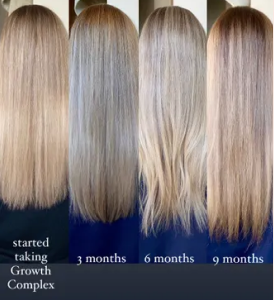
Hair grows approximately half an inch per month. The follicle cycle from anagen through telogen takes three to six months to complete. Any supplement working on this system will not produce visible results in two or three weeks. Expect reduced shedding within 60 to 90 days if the supplement is addressing a real deficit, and visible density improvement after six months of consistent daily use.
How Growth Complex and Beauty Sleep Fit In
Growth Complex provides Cynatine HNS, biotin, zinc, selenium, vitamin C, vitamin E, vitamin B5, and BioPerine at disclosed individual doses. No proprietary blends. Each ingredient is included for a specific, documented reason. For the sleep dimension of hair cycling, Beauty Sleep supports the deep-sleep phase during which growth hormone is secreted, which is directly relevant to hair growth rate and anagen duration.


