


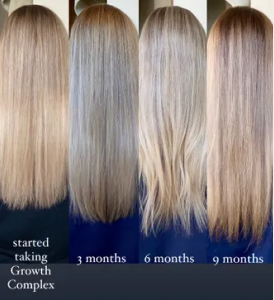


One of the most searched questions by people who have experienced significant hair shedding is when they can expect to see their hair coming back. The answer depends on what caused the shed in the first place, and the timelines differ meaningfully by cause. Here is a realistic breakdown.
Telogen Effluvium Regrowth Timeline
Telogen effluvium (triggered by stress, illness, weight loss, postpartum hormones, nutritional depletion) follows a predictable timeline:
- Month 1 to 3 after trigger: shedding increases as the follicles that shifted to telogen complete their resting phase. This is the alarming period.
- Month 3 to 5 after trigger: shed typically peaks and begins to slow. The first new hairs may emerge at the hairline as short, fine baby hairs.
- Month 6 to 9: visible new growth is more apparent. Short hairs along the hairline and at the part line signal that follicles have returned to anagen.
- Month 9 to 12: for most people, the shed has resolved and regrowth is underway. Hair that grew in month 3 is now 1.5 to 2 inches long.
- Month 12 to 24: new growth continues to extend. Full density restoration for most telogen effluvium presentations is achieved within 12 to 18 months of the shed peak.
Androgenetic Hair Loss Regrowth Timeline
Androgenetic alopecia (pattern hair loss) has a different, slower picture. Miniaturized follicles that have been producing progressively finer hair over years cannot be reversed to full-diameter production without addressing the androgenetic mechanism (typically with minoxidil, finasteride, or dutasteride). The realistic timeline with medical treatment:
- Months 1 to 4: shedding may initially increase as minoxidil pushes follicles from a miniaturized state into a new cycle. This is a sign the treatment is working, not failure.
- Month 6: first visible density improvement for people whose follicles are responding to treatment.
- Month 12 to 24: peak response to medical treatment for most people.
Nutritional supplementation alongside medical treatment supports the follicle environment but does not independently reverse androgenetic miniaturization.
Post-Breakage Regrowth
If the 'regrowth' you are waiting for is actually re-lengthening of hair that broke rather than shed from the follicle, the timeline is purely mathematical: hair grows approximately half an inch per month. Breakage at 3 inches from the scalp will require six months to return to 6 inches.
How to Support Regrowth
Growth Complex supports the anagen phase by providing the nutritional inputs follicle matrix cells need: Cynatine HNS as the keratin raw material, zinc for matrix cell function, selenium for antioxidant protection and thyroid hormone support. The Derma Roller (0.5mm, once per week) stimulates growth factors at the follicle level through the wound-healing response. The Complete Hair Revival System combines all elements of the internal and topical approach.
Starting Growth Complex before regrowth becomes visible is not starting too early. The supplement supports the anagen phase as follicles return to it, making the new growth as robust as possible from the start.
What Regrowth Looks Like
New anagen hairs emerging after a telogen effluvium shed are often finer than the hairs they are replacing, at least initially. They grow in as short, wiry-looking hairs at the hairline and part line. Over three to six months of continued growth, these hairs thicken to their normal diameter. The 'baby hair' phase is normal and signals recovery, not a sign that the regrowth will remain thin.
Managing Expectations During Regrowth
The most difficult phase of hair regrowth is typically between months three and six, when the shedding has peaked and begun to slow but the new growth is not yet long enough to be cosmetically visible. This period feels like a plateau but is actually the recovery phase where the most important follicle activity is occurring.
Staying consistent with both internal supplementation and topical support during this period is important. The new anagen hairs are emerging and growing during these months; they simply need more time to be long enough to contribute to visible density. Part-width photographs taken monthly during this period, under identical lighting conditions, provide the most reliable evidence of progress before the visual milestone is reached.


