



Most conversations about hormones and hair loss focus on estrogen or DHT. Progesterone rarely comes up, even though its decline plays a real role in hair thinning, particularly for women in their 30s, 40s, and beyond.
Here is what progesterone actually does for your hair, what happens when levels drop, and why paying attention to this hormone may fill in a gap that other explanations miss.
What Progesterone Does for Hair Follicles
Progesterone has two protective mechanisms that are relevant to hair. First, it competes with testosterone for the 5-alpha reductase enzyme. This is the enzyme that converts testosterone into DHT, the androgen responsible for follicle miniaturization. Early laboratory research found that progesterone can reduce 5-alpha reductase activity in scalp tissue, which means less testosterone gets converted to DHT at the follicle level.
Second, progesterone helps extend the anagen (growth) phase of the hair cycle. When progesterone levels are adequate, hair stays in the active growth phase longer, producing longer, thicker strands before cycling into rest.
When Progesterone Starts to Decline
Progesterone tends to decline before estrogen does during the perimenopause transition. This matters because it means many women experience the effects of low progesterone, including increased androgen influence on the scalp, a decade before they would describe themselves as 'in menopause'.
In the late 30s and early 40s, progesterone levels begin to fall as ovulatory cycles become less consistent. When progesterone drops while androgens remain stable, the ratio shifts. Even without elevated DHT, the scalp may become more androgen-sensitive because the hormonal counterbalance has weakened.
This helps explain why many women start noticing hair thinning years before menopause. It is not always estrogen. It is often progesterone, earlier than expected.
The Estrogen Dominance Connection
When progesterone declines faster than estrogen does, a state called estrogen dominance can develop. This is not about having too much estrogen in absolute terms. It is about having a relative imbalance where estrogen's effects are no longer properly counterbalanced by progesterone.
This imbalance can affect hair in multiple ways: reduced 5-alpha reductase inhibition (more DHT at the follicle), disrupted hair cycle timing, and increased inflammatory signaling in the scalp. Women who experience estrogen dominance often report changes in their hair alongside other symptoms like heavier periods, mood shifts, and bloating.
Synthetic vs. Bioidentical Progesterone
Not all progestogens are the same, and this distinction matters for hair. Bioidentical progesterone, which has the same molecular structure as the hormone your body naturally produces, tends to be hair-neutral or mildly protective because it genuinely competes with testosterone for 5-alpha reductase.
Synthetic progestins (such as levonorgestrel or norethisterone) used in some oral contraceptives and combined HRT formulations have androgenic activity of their own. They can actually worsen hair thinning in women who are androgen-sensitive, because they bind to androgen receptors in the follicle rather than blocking them. This is why some women notice hair thinning when switching from bioidentical progesterone to a synthetic progestin formula.
If you are on hormonal contraception or HRT and noticing hair changes, the type of progestogen in your formula is worth discussing with your prescriber. See the HRT and hair loss post for the full breakdown.
How to Know If Progesterone Is Playing a Role
A hormonal panel that includes progesterone, tested during the luteal phase of your cycle (days 19 to 21 in a 28-day cycle), can give you a baseline. Low luteal-phase progesterone is associated with inadequate ovulation and can persist for years before other symptoms of hormonal change appear.
Other signs that progesterone may be low:
- Hair thinning that began in your mid to late 30s, before other menopause symptoms
- Irregular or heavier periods in the years before menopause
- Difficulty sleeping, particularly in the second half of your cycle
- Mood changes including anxiety that tracks with your cycle
- Hair that seems to grow more slowly than it once did
Supporting Hair When Progesterone Is Low
If hormonal management is something you're pursuing, that is a conversation for a prescriber or specialist. What you can do in parallel is support your follicles nutritionally, particularly by addressing the androgen-related mechanisms that low progesterone leaves unchecked.
Zinc helps regulate 5-alpha reductase activity and is one of the most studied minerals in hair loss research
Selenium supports follicle antioxidant function and thyroid health, both of which are connected to hair cycle regulation
Biotin supports keratin synthesis and is commonly depleted in women with hormonal fluctuations
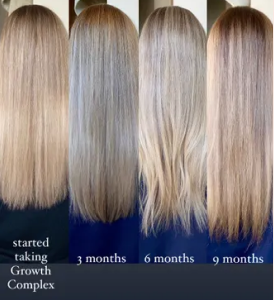
HAIRLOVE's Women's Growth Complex was formulated around these mechanisms, with Cynatine HNS (a bioavailable form of keratin), zinc, selenium, and biotin, designed to support follicle health during the periods of hormonal change when hair is most vulnerable.
A Hormone Worth Paying Attention To
Progesterone rarely gets the attention it deserves in conversations about hair loss. Its role as a natural 5-alpha reductase inhibitor and its influence on the hair cycle length means its decline has real consequences for hair density, often years before women would connect it to hormonal change.
If you are experiencing hair thinning that started in your mid to late 30s or 40s, and estrogen and thyroid have already been checked without a clear answer, ask your doctor to look at progesterone too. For a broader look at how all of these hormones interact, the hormones and hair loss post covers the full landscape.


