



If you're on hormone replacement therapy and your hair seems to be changing, or if you're considering HRT and wondering whether it will help or hurt your hair, you're asking a legitimate question that doesn't have one simple answer.
HRT can help with hair loss. It can also, in some formulations, make it worse. Which one applies to you depends on the type of HRT, the specific hormones involved, and what was driving your hair loss to begin with.
Why Hormones Matter for Hair in the First Place
Estrogen keeps hair follicles in the active growth phase (anagen) for longer. When estrogen levels are healthy, hair cycles are longer and hair appears thicker and fuller. As estrogen declines during perimenopause and menopause, the growth phase shortens, shedding increases, and the overall density of the scalp reduces.
Progesterone works alongside estrogen by helping to counterbalance androgens, particularly DHT, the hormone that causes follicle miniaturization. When both estrogen and progesterone decline in menopause, androgen influence on the scalp increases even if circulating androgen levels stay the same, because the hormones that were counterbalancing them are gone.
A pilot study evaluating estradiol replacement in postmenopausal women with hair loss found improvements in hair density, telogen rate, and hair growth rate after six months of HRT. This is consistent with the biological mechanism: restoring estrogen restores some of its protective effect on the follicle.
When HRT Is Likely to Help
Menopause-related hair thinning: if your hair loss began or worsened around perimenopause or menopause, and it is diffuse rather than patterned, HRT is most likely to be beneficial
Estrogen-progesterone combined HRT: bioidentical combined formulations generally have a neutral to protective effect on hair
Transdermal delivery (patches, gels, creams): delivers hormones more steadily and with a more predictable follicle response than oral HRT in some women
When HRT May Not Help (or May Worsen Thinning)
Not all HRT formulations are created equal for hair. Certain synthetic progestins, particularly those with higher androgenic activity, can actually trigger or worsen hair thinning by mimicking the effect of DHT at the follicle. This is distinct from natural progesterone, which tends to be hair-neutral or mildly protective.
If you're on combined HRT and experiencing thinning, the progestin component is worth discussing with your prescriber. Switching to a formulation with a lower-androgenicity progestin or to bioidentical progesterone may make a difference.
Progestin-only HRT with high androgenic activity: levonorgestrel and norethisterone are two synthetic progestins with androgenic properties that may worsen hair loss
HRT started after significant hair has already been lost: while HRT may slow further loss, it is unlikely to reverse follicle miniaturization that has already occurred
Hair loss with a strong androgenetic pattern rather than purely hormonal cause: HRT addresses the hormonal environment but doesn't directly counteract the genetic follicle sensitivity that drives androgenetic alopecia
The Androgen-to-Estrogen Ratio Is What Actually Matters
The clearest way to think about HRT and hair is in terms of this ratio. In perimenopause and menopause, estrogen and progesterone decline while androgens remain relatively stable. The relative influence of androgens on the scalp increases even without a rise in androgen levels.
HRT works by restoring some of the estrogen and progesterone that were providing protection. If the formulation chosen is one that includes androgenic progestins, you may restore some estrogen while inadvertently adding androgenic pressure, which is why the specific formulation matters so much.
What to Discuss With Your Doctor
What type of HRT you're on: estrogen-only, combined, bioidentical, or synthetic
The progestin in your combined formula and its androgenic activity profile
Whether your hair loss pattern is diffuse (hormonal) or patterned (androgenetic), as the two respond differently
Whether a dermatology referral makes sense if hair loss is a primary concern
Please discuss any changes to or additions of hormone therapy with your prescriber. HRT decisions should be made in consultation with a healthcare provider based on your full medical history.
Supporting Your Hair Alongside HRT
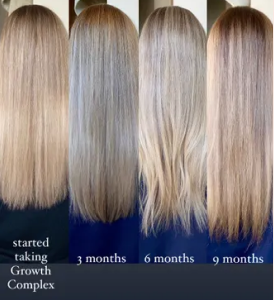
Nutritional support for your follicles matters regardless of whether you're on HRT. Zinc, selenium, and biotin all support healthy follicle function. Clinically studied ingredients like Cynatine HNS in HairLove's Women's Growth Complex may help support hair strength and thickness during the hormonal transition. For a broader look at how estrogen and progesterone interact with hair, the hormones and hair loss post covers the full landscape.
There Is No One-Size Answer
HRT is not a guaranteed hair fix, and it is not a guaranteed hair risk. The outcome depends heavily on your specific formulation, your baseline hair loss pattern, and where you are in the hormonal transition. For women whose thinning is primarily driven by menopausal hormone changes, the right HRT formulation may be genuinely helpful. For women with significant androgenetic alopecia, HRT alone is unlikely to reverse established follicle miniaturization.
The most useful next step is a conversation with your prescriber that treats hair as a legitimate part of the discussion, not an afterthought. If perimenopause-specific hair concerns are relevant, the perimenopause and thinning hair post is also worth reading.


