



When women think about the hormonal causes of their hair loss, testosterone is not usually the first place they look. But for a significant proportion of women with thinning hair, androgens — including testosterone — are playing a more central role than they realize.
Testosterone in Women: Normal and Abnormal
Women naturally produce testosterone — in the ovaries, adrenal glands, and peripheral tissues — at levels roughly 10 to 20 times lower than men. At normal levels, it contributes to libido, energy, and bone density. Hair loss occurs when that balance shifts: either because testosterone or DHT rises above normal, or because the hormones that counterbalance androgens decline.
How DHT Affects Women's Follicles
The mechanism is the same as in men — DHT binds to androgen receptors in scalp follicles, shortening the anagen phase and gradually miniaturizing the follicle — but the expression is different. In women, this presents as diffuse thinning across the crown and widening of the part line rather than the receding hairline pattern seen in men.
Women with female pattern hair loss have higher 5-alpha reductase activity in frontal follicles and higher androgen receptor density — even when serum androgen levels are within normal range. This is why 'normal' testosterone does not rule out androgenetic alopecia.
Conditions That Raise Androgens in Women
PCOS
The most common cause of elevated androgens in women of reproductive age, affecting 8 to 13% of women globally. Women with PCOS often have elevated free testosterone and higher DHT activity at the scalp.
Perimenopause and Menopause
As estrogen and progesterone decline, androgens become relatively more dominant even without rising in absolute terms. This is the most common hormonal driver of hair thinning in women over 40. The progesterone and hair loss post covers this mechanism in detail.
Androgenic Progestins in Contraceptives or HRT
Some progestins in hormonal contraceptives (notably levonorgestrel and norethisterone) have androgenic activity and can worsen hair loss in women who are androgen-sensitive.
What Bloodwork Can Tell You
- Total and free testosterone — free testosterone is often more clinically relevant
- DHEAS: an adrenal androgen that can elevate without total testosterone rising
- SHBG (sex hormone binding globulin): low SHBG means more free testosterone circulating
- LH and FSH: helpful for assessing PCOS and menopausal status
- Prolactin: elevated prolactin can cause hair loss independently
How to Support Hair Health
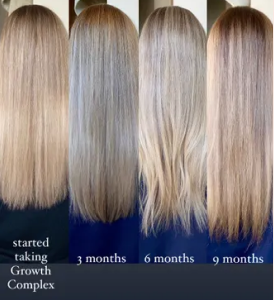
Treatment of underlying conditions — managing PCOS, adjusting hormonal contraception, addressing adrenal dysfunction — is the most effective approach. Nutritional support matters in parallel. Women's Growth Complex provides Cynatine HNS, zinc, selenium, and biotin to support follicle health during periods of hormonal change. For a broader look at all the hormones involved, see the hormones and hair loss post.


