


The Weight Comes Off. Then, Months Later, the Hair Starts to Go.
Hair shedding has quietly become the GLP-1 side effect nobody warns women about, and new research suggests it is far more common than the drug trials implied. Here is why it happens, why it blindsides so many patients, and how one woman got her hair back without giving up her progress.

The first thing Aleah Crowe wants you to know is that her medication worked. The weight came off. Her energy came back. She felt, in her words, incredible. Then, a few months into her GLP-1 journey, she found herself standing in her bathroom holding what she describes as far too much of her own hair, with no idea the two things could be connected.
"I was thinning pretty badly. Yes, it is a real side effect, and yes, it is more common than anyone tells you. I felt blindsided by it."
She is not an unusual case. As GLP-1 medications like Ozempic, Wegovy, Mounjaro, and Zepbound have reached millions of American women, dermatologists have started tracking a pattern the original drug trials barely registered: significant hair shedding that arrives months after the weight loss begins, in patients who were never told to expect it.
A side effect hiding in plain sight
If you only read the prescribing information, hair loss looks like a footnote. In the clinical trials that brought these medications to market, roughly 3 to 7 percent of participants reported it. The real-world numbers tell a different story.
A 2026 survey study of 152 current and former GLP-1 users found that 70 percent reported noticeable hair shedding, roughly ten times the trial rate, and nearly 4 in 10 of those who stopped their medication named hair loss as a reason they quit. The effect scaled with success: among patients who lost 15 percent or more of their body weight, the figure climbed above 80 percent.
Large database studies point the same direction. A propensity-matched analysis of more than 400,000 patient records found that semaglutide users were 43 percent more likely to develop new-onset hair loss than matched controls, and tirzepatide users 68 percent more likely. In both datasets, women carried most of the burden. In the survey research, being a woman more than tripled the odds of shedding.
of GLP-1 users in a 2026 survey study reported noticeable shedding
was the rate reported in the original clinical trials
day typical delay between the trigger and visible shedding
None of this means the medications are damaging hair follicles. The mechanism, dermatologists broadly agree, is older and better understood than the drugs themselves.
The biology of a blindside
The condition has a name: telogen effluvium. Hair follicles are among the most metabolically demanding tissues in the body, and they are also among the most expendable. When calories drop sharply, the body triages. Nutrients go first to the organs that keep you alive, and hair gets moved to the back of the line. Under that stress, an unusually large share of follicles shift together into their resting phase, called telogen. A few months later, all of those resting hairs release at once.
That built-in delay of roughly 60 to 90 days is the cruelest part of the condition, because it disconnects cause from effect. The shedding a woman sees in her shower in month four traces back to a nutritional deficit that opened in month one. By the time it is visible, it has been building for a season. It is also why so many patients, like Crowe, never connect it to their medication at all.
The pattern is well documented outside the GLP-1 world. After bariatric surgery, which produces a similarly rapid drop in intake, studies have found that as many as 57 percent of patients experience significant shedding within three to six months. GLP-1 medications appear to be producing the same physiology on a much larger scale.
There is one more detail that matters for what comes next: hair is roughly 95 percent keratin, a protein the body must continuously manufacture. Keratin production is exactly the kind of expensive, nonessential project a calorie-restricted body cuts first. Survey data bears this out. In the 2026 study, three quarters of GLP-1 users were not eating enough protein, and deficiencies in minerals tied to hair cycling, including zinc and iron, were widespread.
The short version, in plain English
-
Your follicles are hungry
Hair needs a steady supply of protein, zinc, selenium, and energy to keep growing. When you are eating a lot less, your body quietly reprioritizes. The essentials get fed first, and hair gets treated as optional.
-
Hair is mostly keratin
Around 95% of it, in fact. When your body is running lean on the raw materials, keratin production is one of the first things it dials back.
-
The delay is the sneaky part
Follicles do not shed the second the deficit starts. They slip into a resting phase and then let go weeks later, so by the time you actually see the shedding, the trigger happened a couple of months ago. That is exactly why it felt so random and out of nowhere to me.
The encouraging flip side: telogen effluvium is not scarring hair loss. The follicles are not dead, only dormant. Dermatologists who study GLP-1 patients now recommend the same playbook used for bariatric patients: keep the medication if it is working, and close the nutritional gap underneath it, with particular attention to protein, zinc, and selenium. This is a supply problem, and supply problems have answers.
Why the first fixes usually fail
The standard first move, for most women, is a biotin gummy. It rarely resolves the problem, and the reason is worth understanding. Biotin helps the body convert raw materials into keratin, but most people are not biotin deficient to begin with. If the raw materials themselves are missing, adding more biotin is like hiring more builders for a site with no lumber.
The obvious next thought, taking keratin itself, runs into an absorption problem. Keratin in its natural form is extremely difficult to digest, which is what makes it durable as hair and nearly useless as a supplement. Most keratin products pass through the body largely intact.
What worked for her
Crowe eventually landed on Growth Complex, a hair supplement from HAIRLOVE, a woman-founded hair wellness brand whose founder formulated it after her own severe shedding episode. What sets the formula apart is its core ingredient, Cynatine HNS, a patented, solubilized form of keratin engineered to be absorbable, so it can actually reach the follicle instead of passing through.
Unlike most ingredients in the hair aisle, this one has published human data. In a randomized, double-blind, placebo-controlled trial published in The Scientific World Journal, women taking 500 milligrams of Cynatine HNS daily saw hair shedding fall by up to 46 percent over 90 days, alongside measured improvements in hair strength and shine and a higher share of follicles holding in the growth phase. The study was conducted in women ages 40 to 71, not GLP-1 patients specifically, but it targeted precisely the deficit that rapid weight loss creates: not enough usable keratin reaching the follicle.
The rest of the formula reads like a checklist of the shortfalls researchers keep finding in GLP-1 users: chelated zinc and selenium, the minerals tied to hair cycling and thyroid function, plus biotin, vitamin C, vitamin E, and pantothenic acid, with black pepper extract added to boost absorption of the full formula by up to 20 percent. It is two capsules a day, and the company backs it with a 365-day money-back guarantee, a window long enough to actually match how hair biology works. Crowe ordered it with low expectations. She had been burned before.
HAIRLOVE Growth Complex
Built around 500mg of Cynatine® HNS, the clinically studied keratin, plus chelated zinc, selenium, and BioPerine for absorption. Two capsules a day. The one supplement I found aimed at the exact reason GLP-1 users lose hair.
Shop Growth ComplexFrom $46.50/mo · 365-day guarantee
What the next year looked like
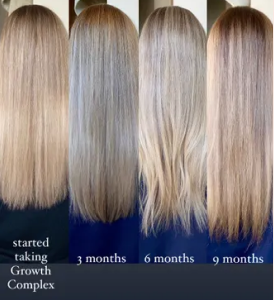
Her results followed the timeline the clinical research would predict, which is part of what makes her story credible. The first few weeks brought nothing dramatic, because the deficit closes invisibly before the mirror catches up. Around month three, fine baby hairs appeared along her hairline, in the places that had thinned first. By month six, the volume was back and the shedding that had frightened her at every wash had settled. A year in, she describes having the hair she had in her twenties.
"I spent months scared I was going to lose my hair. I spent the next year watching it come back. I am truly grateful I found this when I did."
 Start
Start
 Mo 3
Mo 3
 Mo 6
Mo 6
 Mo 9
Mo 9
 Now
Now
Swipe to see all five
She is not an outlier
Scan the verified reviews on HAIRLOVE's site and a pattern emerges: the same story, told in slightly different words, by women who found each other's experiences the way people do now, in review sections.
Deana Cavanaugh
Verified PurchaserGLP-1 patient
"I started losing hair when I started a GLP-1. I was shocked that it was worse than post-partum hair loss! I started HAIRLOVE and it ended up being the best decision I ever made. My hair is growing again, the thin spots are filling in, my hair is thicker, and I have never gotten more compliments on the look and health of my hair. So thankful to have found this product."
Pamela Martin
Verified PurchaserGLP-1 patient · recommended by her hairdresser
"Seeing new growth. The GLP-1 did a number on my hair loss and I was becoming really stressed with the amount and the frequency. Now I am seeing a comeback. I am a loyal customer, and my hairdresser is the one who recommended it."
The clock is the whole game
What nobody credible recommends is abandoning a medication that is delivering real health results over a side effect that is both temporary and addressable. Crowe never stopped hers. Anyone starting a supplement alongside a prescription should loop in their prescribing doctor, a step HAIRLOVE itself recommends. But the larger point stands: this is not a choice between the weight loss and the hair. It only feels that way in the months before you understand what is happening.
What the first ninety days look like
-
Wk 1–3 Groundwork
The Cynatine and minerals go to work closing the nutritional gap at the follicle. Nothing visible yet, but this is where it starts.
-
Wk 4–6 Shedding calms down
This is the window where most people notice less hair in the shower and the brush. For me it was the first sign it was working.
-
Mo 3+
The 90-day milestone
New growth shows upBaby hairs at the hairline, more density over time. This lines up with the 90-day mark in the clinical trial, and it is exactly when I saw mine.
You do not have to choose between the weight loss and your hair.
Growth Complex closes the nutritional gap that rapid weight loss creates, with the clinically studied keratin your follicles can actually use. Two capsules a day, backed by a full 365-day money-back guarantee.
Start With Growth ComplexFree shipping on orders $99+ · 365-day guarantee · No subscription required
