




You started AOD-9604 for fat loss, saw results, and then two or three months later noticed significantly more hair in your brush. You did not expect that. Most people using this compound do not.
Here is what is actually happening, why it follows the pattern it does, and what it means for your hair long-term.
What AOD-9604 Is
AOD-9604 is a synthetic 15-amino-acid fragment of the growth hormone molecule, specifically the C-terminal region (residues 176-191). It was developed as an anti-obesity compound because it mimics growth hormone's fat-burning (lipolytic) activity without binding to the full GH receptor.
That last detail is important for hair: because AOD-9604 does not activate the full GH receptor, it does not raise insulin-like growth factor 1 (IGF-1). IGF-1 is a hair growth promoter. The absence of that effect is one reason AOD-9604 is a cleaner compound profile than some other GH-related peptides, but it also means there is no hormonal hair-growth offset to balance against the shedding that can accompany fat loss.
Why AOD-9604 Can Cause Hair Shedding
AOD-9604 does not directly damage hair follicles. The mechanism runs through a different pathway: the physiological stress of rapid fat loss.
A 2024 retrospective study in Annals of Dermatology documented telogen effluvium in patients experiencing significant weight loss, confirming that the rate and scale of fat loss itself is the trigger, independent of the method used to produce it. Hair follicle matrix cells are among the most rapidly dividing cells in the body. When caloric and nutrient availability drops sharply, these cells are among the first to be deprioritized as the body conserves resources for essential functions.
The result: a large cohort of follicles shifts simultaneously from the active growth phase (anagen) into the resting phase (telogen). They do not shed immediately. The telogen phase lasts approximately three months, which is why the shedding shows up well after the fat loss, not during it.
The Two-to-Three-Month Delay
This timing confuses most people. They see the shedding two or three months after their most aggressive fat-loss phase, when they may have already slowed the protocol or changed their approach. The separation in time makes it easy to miss the connection.
Understanding the timeline is important because it means: (1) the trigger is already in the past when the shedding begins, (2) the shedding will continue for the duration of the telogen phase even if the trigger resolves, and (3) the hair is almost certainly already regrowing by the time the shed peaks.
Is This Permanent?
In the vast majority of cases, no. Telogen effluvium from fat loss does not permanently damage hair follicles. The follicle is temporarily resting, not destroyed. Once the rate of fat loss slows, nutritional status stabilizes, and the follicle cycle normalizes, regrowth follows.
The exception worth noting: people with pre-existing androgenetic alopecia (pattern hair loss) may find that the physiological stress of fat loss accelerates the progression of thinning that was already underway. In that case, the pattern loss continues even after the telogen effluvium resolves, because they are distinct processes. Diffuse shedding across the whole scalp is the telogen effluvium signature. Progressive thinning concentrated at the crown or hairline is the androgenetic signature. Both can coexist.
How to Tell Stress Shedding From Pattern Loss
-
Telogen effluvium: diffuse shedding across the entire scalp, increased hairs on the pillow and in the brush, often with a clear temporal connection to a stressor two to three months prior. Typically stabilizes within six months
-
Androgenetic alopecia: gradual thinning concentrated at the crown and hairline, widening of the part, miniaturizing hairs. Progresses over years without treatment
- A dermatologist can distinguish these with a pull test, trichoscopy, or biopsy if the picture is unclear
Supporting Your Hair Through a Fat-Loss Phase
The most actionable approach during aggressive fat loss is nutritional. The follicle needs protein (hair is made of keratin), iron (check ferritin, not just hemoglobin), zinc, and selenium to function optimally. Caloric restriction reduces all of these.
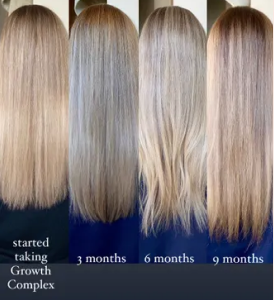
HairLove's Women's Growth Complex provides Cynatine HNS (a bioavailable form of keratin clinically studied for hair strength and reduced shedding), alongside zinc and selenium. This is support for the follicle environment during a calorie-restricted phase, not a claim that it prevents or stops shedding.
Fragile, shedding hair also benefits from gentler handling. The Denman Brush reduces mechanical breakage, the microfiber towel minimizes friction during drying, and the silk pillowcase reduces overnight mechanical stress on hair that is already in a fragile shedding phase.


