




MK-677 generates more hair-loss discussion than any other GH secretagogue. It is also the most misunderstood one in those conversations. Here is a clear-eyed look at what the evidence actually says about ibutamoren and hair.
What MK-677 Actually Is
MK-677 (ibutamoren) is often grouped with peptides but is technically a non-peptide ghrelin receptor agonist taken orally. It mimics ghrelin's action at the pituitary, stimulating release of growth hormone and subsequently raising IGF-1. Because it is oral and produces strong, sustained IGF-1 elevation, it is the most widely used GH secretagogue in body recomposition contexts.
IGF-1 is a hair growth factor. This is not in dispute. So the central question is: if MK-677 raises IGF-1, why do some users report shedding?
The Case for Hair Benefits
Multiple users and some clinical context support the idea that MK-677 improves hair. IGF-1 extends the anagen phase, supports dermal papilla function, and promotes follicle survival. Some people on MK-677 report thicker, faster-growing hair. This is the expected biological outcome of sustained IGF-1 elevation in people whose follicles are not androgen-sensitive.
The Cortisol Question
The most commonly cited shedding mechanism in MK-677 communities is cortisol elevation. The argument goes: MK-677 raises cortisol, cortisol holds hair follicle stem cells quiescent, and shedding follows.
The honest answer is that this question is not settled. A 7-day clinical study by Copinschi et al. assessed adrenocortical function in normal young men on MK-677 and did not find a clean, significant cortisol rise at the doses studied. The study measured 24-hour GH profiles, IGF-1, and adrenocortical function and concluded that MK-677 did not significantly alter cortisol or cortisol pulse characteristics in this short-term context.
Longer-term use at higher doses in a recomposition context is not the same as a 7-day study in healthy young men. Forum reports of elevated morning cortisol on MK-677 are common. But they are not a clinical study, and the question of whether MK-677 produces a sustained cortisol rise sufficient to affect the hair cycle has not been answered by clinical research. Present this as what it is: an unresolved question, not an established mechanism.
For context on how cortisol affects follicles when it is elevated: corticosterone has been shown to suppress GAS6 signaling and hold hair follicle stem cells in a quiescent state, preventing follicle regeneration. This is the animal evidence that underlies the cortisol hypothesis.
The Metabolic Angle Unique to MK-677
MK-677 has a documented effect on insulin sensitivity and blood glucose that the other GH secretagogues do not share to the same degree. A 1995 pharmacology study documenting MK-677's biological activities noted that GH secretagogues in this class can affect glucose metabolism. Insulin resistance and metabolic stress can contribute to systemic physiological stress that, in turn, may affect the hair cycle.
This is a secondary and theoretical pathway, but it is another feature of MK-677's profile that distinguishes it from the injectable GH peptides.
Prolactin and Indirect DHT
Some MK-677 users report elevated prolactin on bloodwork. Elevated prolactin is associated with telogen effluvium, though the clinical hair-effect threshold is not precisely defined. Indirect DHT elevation from GH-axis activity has been proposed but is not well-supported by clinical data in the hair literature.
These routes are hypotheses. The fat-loss stressor remains the most defensible explanation for shedding that tracks temporally with MK-677 use in a recomp context.
Individual Variability: The Predisposition Gate
Whether shedding progresses to lasting thinning depends primarily on genetics. DHT miniaturizes follicles only in people with inherited androgenetic sensitivity. For a man with no family history of pattern hair loss, even a modest hormonal shift is unlikely to produce visible miniaturization. For someone already in the early stages of androgenetic alopecia, any androgenic amplification can accelerate a process already in motion.
Supporting Hair While on MK-677
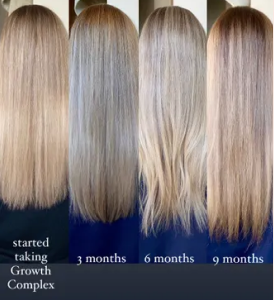
The most actionable response is to support follicle nutrition during the recomp phase. Women's Growth Complex provides Cynatine HNS, zinc, and selenium to support the follicle environment. For fragile shedding hair, the Denman Brush and silk pillowcase reduce mechanical stress. This is support through a shed, not a treatment for androgenetic progression.
For the full shared mechanism explanation across all GH peptides, see the GH peptides hub.
One Additional Consideration Specific to MK-677
MK-677 raises aldosterone modestly and can produce noticeable subcutaneous fluid retention, particularly in the first few weeks of use. While this is not a hair mechanism, it affects body weight readings and can give a misleading picture of fat-loss rate. People who see a slower scale change on MK-677 and reduce calories further in response may be adding a more aggressive caloric deficit on top of the water retention effect, compounding the fat-loss stress signal that drives telogen effluvium.
If you are tracking body composition on MK-677, use measurements and photos rather than the scale alone during the first four to eight weeks to avoid overreacting to fluid weight changes with deeper caloric restriction.


