


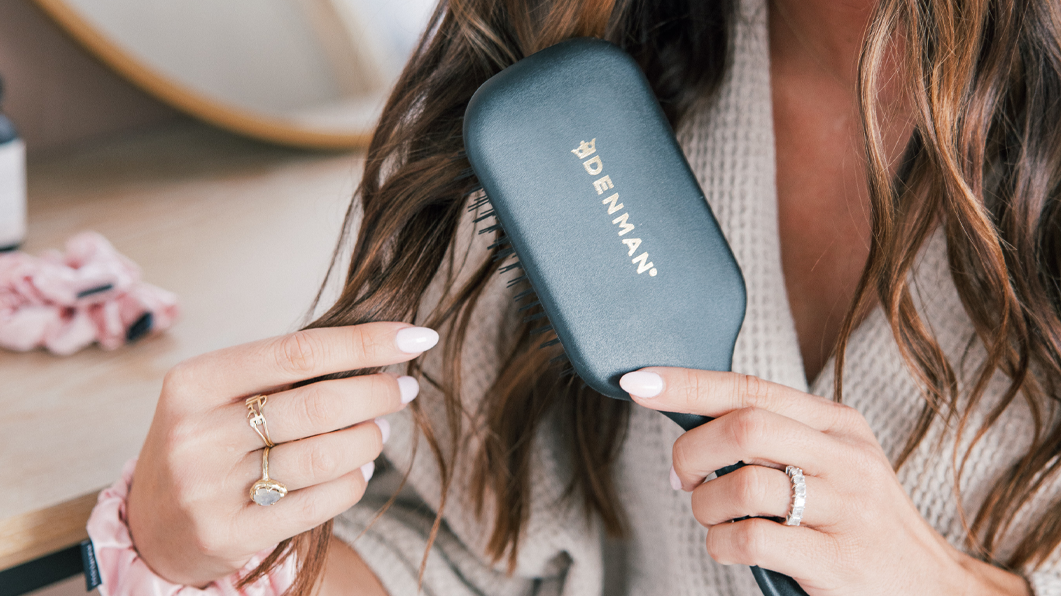

If you have fine or thinning hair and are considering the Denman brush, the most common questions are: will it be too aggressive for my hair? Will the tension cause breakage? Is the 7-row configuration the right one? Here is a direct, honest answer to each of those questions.
Why Fine Hair Buyers Are Cautious About the Denman
The Denman brush is well-known in the curly hair community for curl definition and detangling. Curly hair typically has more texture and resistance than fine straight hair, so buyers with fine or low-density hair often wonder whether a brush designed for that application will be too heavy-handed for their delicate strands.
The short answer: the Denman's design makes it more appropriate for fine hair than most other brushes on the market, not less. Here is why.
What Makes the Denman Suitable for Fine Hair
- Rubber cushion base: the base of the Denman flexes when it encounters resistance. This means that when the brush hits a tangle on fine hair, the base deflects rather than transmitting the full force through to the strand. This is the opposite of a rigid-base brush, which would drag the tangle through with consistent force.
- 7-row configuration for the right spacing: the 7-row Denman has wide enough row spacing to move through hair without the compression that a 9-row or larger brush creates. For fine, low-density hair, that compression creates excessive friction and pulling. The 7-row is the appropriate choice for fine or thinning hair.
- Smooth pin tips: the Denman's pins have smooth, rounded tips that do not snag the cuticle surface. This reduces the micro-damage to the cuticle that contributes to frizz and eventual breakage over repeated use.
The Technique That Prevents Breakage on Fine Hair
The brush is correct. The technique matters equally. For fine hair:
- Use on dry or damp-not-wet hair. Wait until hair is at least 80% dry before introducing any brush.
- Start at the ends and work upward in sections no wider than 2 to 3 inches for fine hair. Narrower sections create less combined tension at any one moment.
- Use a lighter grip than you would on thick hair. The cushioned base does the work. Pressing harder defeats the flex mechanism.
- Hold the section above where you are brushing to prevent tension from transmitting to the root.
Using the Denman in the Full Routine
The Denman Hair Brush works best as the final styling step after the hair has been protected at the highest-risk moment (post-shower). The sequence: Luxury Hair Towel to remove excess water without friction, damp or dry hair air-dried to at least 70%, finger-detangle any significant knots, then Denman from the ends upward. This sequence reduces mechanical stress at every step before the brush is introduced.
Common Mistakes With the Denman on Fine Hair
- Using it on soaking wet hair immediately post-shower: the hair's structural integrity is at its lowest when fully saturated. Wait.
- Using the 9-row configuration on fine or thinning hair: more rows mean more contact at once, which creates more combined tension on a low-density section. The 7-row is the right choice.
- Brushing the roots first on fine hair: this compresses any tangles against the scalp, making them harder to remove and increasing the force required. Always ends first.
The Denman in the Context of a Full Hair Protection Routine
The Denman Brush works best as one step in a sequence designed to protect fine hair at its most vulnerable moments rather than as a standalone tool. The sequence that produces the least cumulative daily breakage: Luxury Hair Towel post-shower to remove excess water without friction, partial air-dry to damp, finger-detangle any significant knots, then Denman from the ends upward. This sequence addresses the highest-risk mechanical moments before the brush is introduced, so when the brush does contact the hair, most of the tension-generating obstacles have already been cleared.
Over time, this consistent protective routine produces measurably less breakage than any individual element of it would on its own. Hair that is not being broken off in the post-shower window retains more length and appears denser over months of consistent practice.


