



Hair supplement marketing is excellent. The labels are appealing, the claims are confident, and the ingredient lists are long. What the marketing rarely helps with is understanding whether the formula will do anything meaningful. Here is how to read a supplement label so the difference between a well-formulated product and a marketing exercise becomes obvious.
Start With the Supplement Facts Panel
Every legitimate supplement sold in the US includes a Supplement Facts panel that lists every ingredient, its form, and the amount per serving. This is the regulated part. The front of the label is marketing. The Supplement Facts panel is data.
Look at Individual Doses, Not Just the Ingredient List
The most common label trick in the supplement industry is the proprietary blend: a group of ingredients listed under one heading with a total weight but no individual doses disclosed. If a label says 'Hair Support Blend 350mg' and lists eight ingredients, you have no way of knowing whether any single one is present at a meaningful level. A clinically relevant zinc dose for hair is typically 8 to 11mg. If zinc is buried in a 350mg blend with seven other ingredients, it could be present at 1mg or 0.1mg. Both appear on the label identically. Avoid proprietary blends for anything intended to address a clinical deficit.
Ingredients That Should Have Real Disclosed Doses
Biotin: at least 100% of the recommended daily value (30mcg). Megadoses of 5,000mcg or more are not more effective unless significant deficiency is present.
Zinc: 8 to 11mg elemental zinc. Form matters: zinc picolinate and zinc bisglycinate are better absorbed than zinc oxide.
Selenium: 55 to 70mcg. Selenomethionine is the preferred form for absorption.
Cynatine HNS (bioavailable keratin): if a formula includes keratin, look for Cynatine HNS by name. Generic 'keratin' in a supplement is typically poorly absorbed. Cynatine HNS is the solubilized form with clinical data.
BioPerine: 5mg is the standard effective dose shown in absorption studies. Smaller amounts are largely decorative.
Ingredients to Be Skeptical Of
Collagen at low doses provides amino acids the body may use in various ways, but it is not a direct hair-building ingredient at doses found in most hair supplements.
Any ingredient in a proprietary blend without an individual dose is automatically suspect regardless of what the ingredient is.
Putting It Together: A Label Checklist
When evaluating any hair supplement label, run through this quick checklist. Are all ingredients listed individually with disclosed doses, or are they grouped in a proprietary blend? Are the zinc and selenium listed with their specific forms (picolinate, bisglycinate, selenomethionine) or just the mineral name? Is the biotin dose in the range relevant to your actual intake needs, or is it a megadose that signals marketing over science? Is there an absorption enhancer like BioPerine or is each ingredient being delivered in isolation? Does the serving size match what you are willing to take daily?
A formula that lists individual doses, uses bioavailable ingredient forms, includes an absorption enhancer, and avoids proprietary blends is making a legitimate scientific argument for its formulation. One that relies on proprietary blends, megadoses of biotin, and a long impressive-sounding ingredient list without disclosed amounts is relying on marketing.
HAIRLOVE's Label
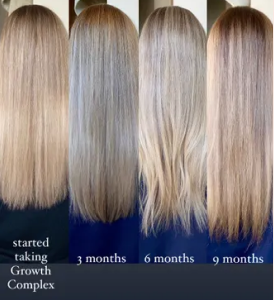
Growth Complex lists every ingredient with its individual dose. The formula includes Cynatine HNS, biotin, zinc, selenium, vitamin C, vitamin E, vitamin B5, and BioPerine. No proprietary blends. The Inside-Out Bundle adds topical Scalp Serum for anyone who wants to address the scalp environment alongside the internal nutritional layer.
A Note on Collagen in Hair Supplements
Collagen is frequently included in hair supplements because it sounds relevant: hair is protein, collagen is protein. But collagen is rich in glycine, proline, and hydroxyproline, while keratin is rich in cysteine and serine. These are different amino acid profiles. Collagen supplements provide amino acids the body may use in various ways, but they are not a targeted keratin-building ingredient. For direct hair shaft support, Cynatine HNS provides the keratin structure the follicle actually uses, rather than amino acids it must then re-route toward hair production.


