




Why Oral Minoxidil Is Getting So Much Attention
What was a rarely-discussed off-label option has moved into the mainstream of dermatology practice, driven by a growing evidence base and a 2025 consensus statement published in JAMA Dermatology from 43 hair loss specialist dermatologists across 12 countries formalizing best practices for its use.
Topical minoxidil has been available for decades. The oral form is newer to hair loss treatment, used at doses far below what was historically prescribed for blood pressure, and the results at these low doses are showing meaningful improvements for women with pattern hair loss.
What the Evidence Shows
A 2025 systematic review and meta-analysis published in Frontiers in Pharmacology, pooling data from 27 studies and 2,933 patients, confirmed that low-dose oral minoxidil (LDOM) is both safe and effective for treating alopecia including female pattern hair loss. Patients treated with oral minoxidil showed significant improvements in hair density and growth rate, and individuals on 1 mg oral minoxidil did not encounter serious adverse reactions throughout the treatment period.
A randomized controlled trial found no statistically significant difference in efficacy between 1 mg oral minoxidil and 5% topical minoxidil for women with pattern hair loss, meaning oral administration may work as well as the topical for many women while being considerably easier to maintain consistently.
Common Questions Women Ask
What are the side effects?
The most commonly reported side effect at low doses is hypertrichosis: fine hair growth on the face, arms, or body. This is dose-dependent and typically mild at doses used for hair loss. Cardiovascular effects are minimal but require monitoring, particularly for women with existing cardiovascular conditions.
Is it safe long-term?
The JAMA Dermatology 2025 consensus reflects expert agreement that LDOM is well-tolerated for long-term use at appropriate doses under physician supervision. Monitoring is recommended.
Can I use it if I am pregnant or breastfeeding?
No. Minoxidil is not considered safe during pregnancy or breastfeeding in any form. Discuss this clearly with your prescribing physician.
What is a realistic expectation for results?
Shedding typically decreases within 2-3 months. Visible density improvement generally appears between months 4 and 6. Results are maintained only with continued use; stopping treatment reverses gains over time.
How Nutritional Support Fits In
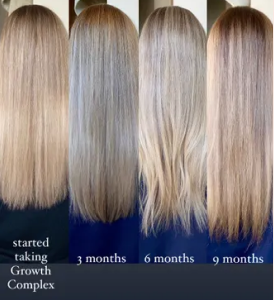
Oral minoxidil addresses the circulatory and follicle-activation side of hair loss. It does not address nutritional deficiencies, which are present in many women with pattern loss and which significantly affect how well any treatment works. HAIRLOVE Growth Complex provides the nutritional foundation: Cynatine HNS, Zinc, Selenium, and Vitamin C. Women using prescription treatment alongside consistent nutritional support are addressing both the vascular mechanism and the nutritional environment their follicles operate in.
This post is informational only.


