Vitamin C
Essential Antioxidant for Hair, Skin & Immune Support
Vitamin C plays a critical role in collagen synthesis, antioxidant defense, and scalp health support. It helps protect hair follicles from oxidative stress while supporting stronger skin and nails.
The Ingredient
What Is Vitamin C?
Vitamin C supports collagen production, iron absorption, and antioxidant defense — three essential systems involved in healthy hair growth.
Vitamin C (ascorbic acid) is a water-soluble antioxidant and one of the most versatile micronutrients in human health. For hair specifically, it plays three distinct and important roles.
First, Vitamin C is an essential co-factor for collagen synthesis. Collagen is the structural protein that forms the dermis of the scalp — the layer of skin in which hair follicles are embedded. Without adequate collagen, the scalp loses structural integrity, which can compromise follicle anchoring and disrupt the hair growth cycle.
The link between Vitamin C and collagen production is mediated by its role as a co-factor for the enzymes prolyl hydroxylase and lysyl hydroxylase, which are required to form stable collagen crosslinks.
Second, Vitamin C dramatically enhances the absorption of non-heme (plant-based) iron. Iron deficiency is one of the most common nutritional causes of hair loss — particularly in women. Vitamin C converts iron from ferric (Fe³⁺) to ferrous (Fe²⁺) form in the intestine, making it up to three times more absorbable.
Third, as a powerful antioxidant, Vitamin C protects hair follicles and scalp cells from oxidative stress. Free radicals — generated by UV exposure, pollution, inflammation, and metabolic processes — damage follicle cells and are associated with premature hair aging, greying, and loss.
Key Benefits
Supports Collagen Synthesis Essential co-factor for collagen production which forms the scalp dermis where follicles are rooted.
Enhances Iron Absorption Improves non-heme iron absorption by up to 300%, critical since iron deficiency is a leading cause of hair loss in women.
Powerful Antioxidant Protection Helps protect follicle cells from free radical and oxidative stress damage.
Protects Skin & Scalp Supports epidermal barrier function and helps defend against UV-related skin damage.
Supports Long-Term Skin Health Higher dietary intake may play a protective role against melanoma and skin-related cellular damage.
Clinical Evidence
The Science: Clinical
Studies & Research
Multiple published studies support Vitamin C's role in collagen synthesis, antioxidant defense, UV protection, skin health, and follicular resilience.
STUDY 1
Ascorbic Acid Hybrid Compounds Inhibit Melanogenesis and Enhance Collagen Synthesis
Kwak JY, et al. · Archives of Dermatological Research · 2015
Vitamin C derivatives augmented collagen release from human dermal fibroblasts by 120–191% while also inhibiting melanogenesis.
Research on ascorbyl coumarate compounds demonstrated that Vitamin C derivatives significantly increased collagen release while also regulating pigmentation pathways. This highlights Vitamin C's role in supporting the structural collagen matrix of the scalp and overall skin integrity.
View Study →, opens in a new tabSTUDY 2
Higher Dietary Vitamin C Associated with Reduced Risk of Cutaneous Melanoma
Malavolti M, et al. · International Journal of Vitamin and Nutrition Research · 2013
Higher dietary Vitamin C intake was associated with reduced melanoma risk, particularly in younger women.
A population-based case-control study found that higher dietary Vitamin C intake correlated with reduced melanoma risk. Researchers attributed this effect to Vitamin C's antioxidant and anti-carcinogenic activity in skin tissue.
View Study →, opens in a new tabSTUDY 3
Topical Vitamin C Protects Skin from UV-B and UV-A Radiation Damage
Darr D, et al. · British Journal of Dermatology · 1992
Vitamin C significantly reduced UV-induced erythema and phototoxic skin reactions.
Researchers demonstrated that Vitamin C protected skin against UV radiation damage while UV exposure itself depleted Vitamin C reserves in the skin. This supports the importance of replenishing Vitamin C for scalp and follicle protection.
View Study →, opens in a new tabSTUDY 4
Combined Vitamins C and E Reduce Sunburn Reaction and UV-Induced DNA Damage
Eberlein-Konig B, et al. · Journal of the American Academy of Dermatology · 1998
Combined Vitamin C and E supplementation significantly reduced UV-induced DNA damage.
In a placebo-controlled trial, Vitamin C combined with Vitamin E increased resistance to UV-induced sunburn and significantly reduced DNA damage markers. This synergistic antioxidant relationship is why both vitamins are paired in HAIRLOVE formulations.
View Study →, opens in a new tabSTUDY 5
Vitamin C Extends Keratinocyte Viability and Promotes Epidermal Barrier Formation
Boyce ST, et al. · Journal of Investigative Dermatology · 2002
Vitamin C improved keratinocyte viability and promoted healthier epidermal barrier formation.
Vitamin C supplementation improved basement membrane formation and epidermal barrier integrity in cultured skin models. Since hair follicles sit on this matrix layer, maintaining its integrity is important for long-term follicle anchoring and resilience.
View Study →, opens in a new tabShop
HAIRLOVE Products Containing
Vitamin C
Vitamin C is included throughout the HAIRLOVE system to support collagen synthesis, antioxidant protection, and healthy hair growth support.

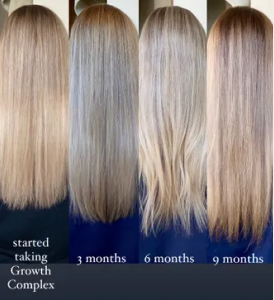
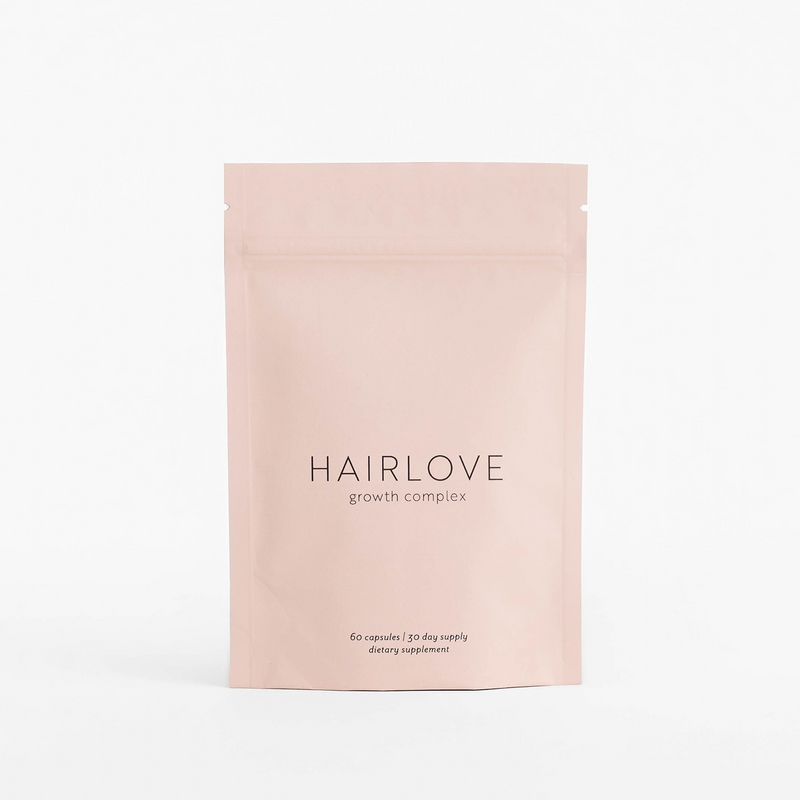
Growth Complex
Contains Vitamin C as a collagen co-factor, iron absorption enhancer, and antioxidant alongside 7 other nutrients.
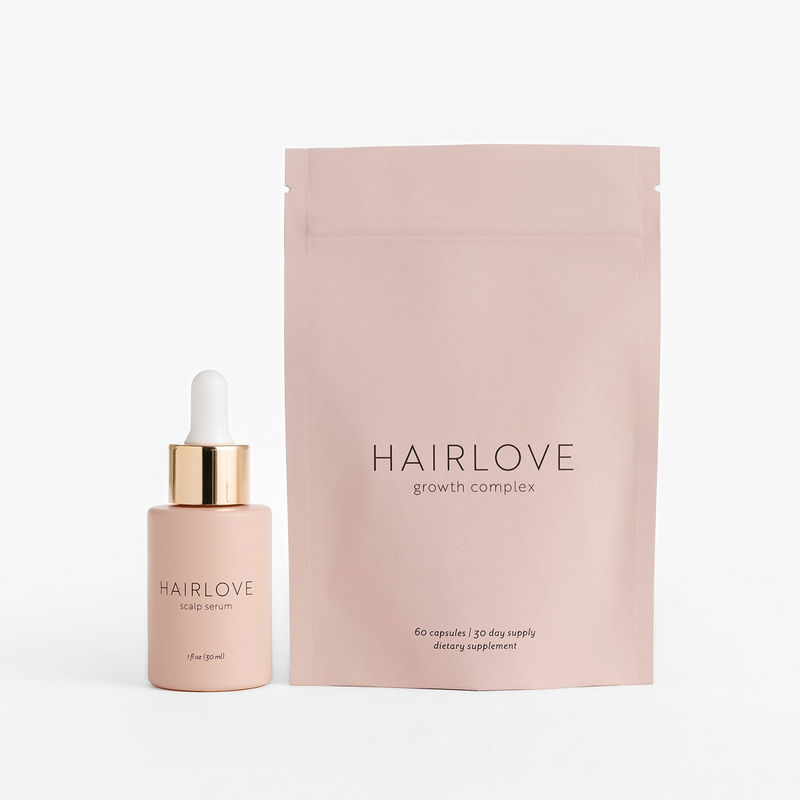
Inside-Out Bundle
Growth Complex + Scalp Serum for comprehensive internal and topical hair wellness support.
Editor's Note
For anyone experiencing diffuse hair shedding, Vitamin C's role in enhancing non-heme iron absorption is particularly relevant. Many women have borderline low ferritin levels that don't register as clinical deficiency but still affect hair growth — and Vitamin C can significantly improve iron bioavailability through dietary iron alone.

