



You've been taking creatine for months. You're stronger, you're recovering faster, and everything is going well. Then you start noticing more hair in the shower drain. Now you're wondering if there's a connection.
It's a fair question. The idea that creatine causes hair loss has been circulating in gyms and fitness forums for years. But the answer is more nuanced than most articles make it sound.
Where the Concern Actually Comes From
Almost every article on this topic points to the same study. In 2009, researchers at a South African rugby institute gave 20 male college athletes a high-dose creatine loading protocol. Over three weeks, they found that DHT levels rose by 56% during the loading phase, opens in a new tab and stayed 40% above baseline during the maintenance phase.
DHT, or dihydrotestosterone, is a hormone derived from testosterone. In men who are genetically predisposed to androgenetic alopecia, DHT binds to receptors in hair follicles and gradually shrinks them — a process called follicle miniaturization. Over time, this shortens the growth phase of each hair cycle until the follicle can no longer produce a visible strand.
So the concern makes biological sense: if creatine raises DHT, and high DHT can contribute to hair loss in susceptible men, there's a theoretical path worth examining.
Here is the critical detail. That 2009 study never measured hair loss, hair density, or any change in follicle health. It only measured hormone levels.
Twelve Studies Later: What the Evidence Actually Shows
Twelve subsequent studies examined whether creatine raises testosterone or DHT at standard doses. None of them replicated the 2009 finding. A 2017 systematic review of creatine safety found no meaningful hormonal disruption.
In 2025, researchers published the most rigorous study to date: a 12-week, double-blind, randomized controlled trial that directly measured hair follicle health in resistance-trained men taking 5g of creatine daily. They assessed hair density, follicular unit count, and cumulative hair thickness. The creatine group showed no significant differences compared to placebo, opens in a new tab on any hair-related measure.
The 2009 study also had meaningful methodological issues. The loading dose was unusually high at 25g daily, the sample was only 20 rugby players whose intensive training protocols independently elevate androgens, and the finding was never replicated, including by a follow-up study from the same lead researcher the following year.
Why Genetics Is the Real Variable
Even if creatine caused a modest rise in DHT, that rise would only matter if your follicles are sensitive to it. Androgenetic alopecia, which accounts for the vast majority of male pattern hair loss, is strongly genetic. It requires both a genetic predisposition and androgen exposure to progress.
Men who are genetically deficient in the enzyme that converts testosterone to DHT do not develop male pattern baldness, opens in a new tab, even with normal testosterone levels throughout their lives. This is one of the clearest pieces of evidence that DHT sensitivity in the follicle, not circulating DHT levels alone, is what drives the process.
If baldness does not run in your family, a minor hormonal fluctuation from creatine is unlikely to affect your hair. If it does, your follicles may already be sensitive enough that any consistent DHT elevation, from any source, could matter over time.
Practical Steps If You're Concerned
- Skip the loading phase. The 2009 study used 25g/day for the first week. Standard maintenance doses of 3 to 5g daily have not produced the same hormonal effects in any subsequent research.
- Watch your scalp, not just your brush. Seasonal shedding, stress, poor sleep, and nutritional gaps are far more common causes of increased shedding than creatine.
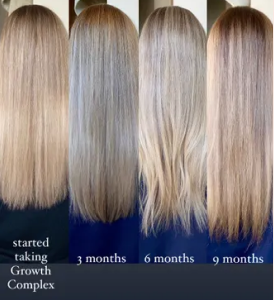
- Support your follicles nutritionally. DHT-sensitive follicles benefit from consistent nutritional support. Men's Growth Complex was formulated around these mechanisms, including Cynatine HNS, a bioavailable form of keratin clinically studied for hair strength and thickness, alongside zinc and selenium.
- Talk to a dermatologist. If you're seeing significant changes in your hairline or density, get an actual diagnosis rather than guessing at causes.
What the Research Tells Us
The current evidence does not support the conclusion that creatine causes hair loss. The concern traces back to a single small study that measured a hormone shift in 20 rugby players and never measured actual hair change. That study has never been replicated. A 2025 trial specifically designed to measure follicle health found no effect at all.
If you have a strong family history of male pattern baldness, be cautious with high-dose loading protocols. But at standard doses, creatine is one of the most researched supplements in sports science, and hair loss is not a documented side effect. For a deeper understanding of how DHT drives follicle miniaturization, the DHT and hair loss post covers the full mechanism.


