



Sermorelin is the oldest and most clinically established compound in the GH peptide group. Its history is different from the newer recomposition secretagogues, and understanding that history is useful for framing the hair question accurately.
What Sermorelin Is
Sermorelin is the 1-29 amino acid fragment of growth hormone-releasing hormone (GHRH), which is the naturally occurring hypothalamic signal that triggers pituitary GH release. It was used diagnostically to assess pituitary GH reserve and was prescribed for age-related GH insufficiency before being withdrawn from the US market in 2008 for commercial rather than safety reasons.
It is now compounded by licensed pharmacies and used off-label. Its mechanism is the same as endogenous GHRH: it stimulates pulsatile GH release that follows the body's natural rhythm.
Why "Physiologic" Matters for Hair
Sermorelin preserves the body's own pulsatile GH pattern, stimulating release in sync with natural peak times (primarily during deep sleep). It does not produce the continuous or sustained IGF-1 elevation of CJC-1295 or the strong sustained levels of MK-677. It is the gentlest of the four compounds in terms of GH axis manipulation.
The hair implications are proportional. GH and IGF-1 are pro-hair. A physiologic pulsatile stimulation of GH, within normal physiologic ranges, is the most hair-favorable of the four GH compound profiles. Any shedding that occurs during sermorelin use is most plausibly attributed to accompanying fat loss or general physiological stress rather than to a direct compound effect on follicles.
The Age Context
Sermorelin's primary user base has historically been people experiencing age-related GH decline, typically those in their 40s, 50s, and beyond. This age group is also the group most likely to be experiencing age-related androgenetic hair thinning independently of any compound use.
Attribution matters here. If a 55-year-old woman starts sermorelin for anti-aging and notices hair thinning six months later, separating the natural progression of age-related hair loss from any compound-related effect requires a careful assessment. Sermorelin's physiologic profile makes it unlikely to have caused the thinning, but the coincidence of timing makes the attribution question worth taking seriously with a dermatologist.
Predisposition Gate and Temporary vs Permanent
The shared mechanism applies: telogen effluvium from fat loss or physiological stress is temporary. Androgenetic miniaturization occurs only in people with inherited follicle sensitivity to DHT. Sermorelin's gentle, physiologic profile makes the androgenetic acceleration hypothesis weakest here.
Supporting Hair at Any Age
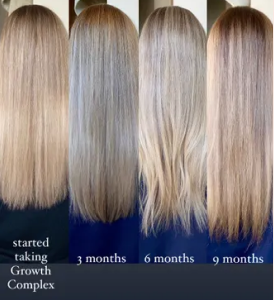
For older users navigating both age-related changes and any physiological effects of sermorelin, nutritional support for follicles is a consistent baseline. Women's Growth Complex provides Cynatine HNS, zinc, and selenium. For a broader look at how hair changes through the decades and what to do at each stage, see the hair-through-the-decades content on the HairLove blog. The silk pillowcase reduces overnight mechanical stress on hair that is naturally becoming more fragile with age.
For the full shared mechanism across all four GH peptides, see the GH peptides hub.
A useful practical note for sermorelin users in the age-related-decline context: the compound is most commonly injected before sleep to align with natural GH pulsatility. This means the dosing regimen itself supports sleep quality, which is one of the indirect variables that influences hair cycling. Sleep deprivation independently elevates cortisol and disrupts growth hormone secretion, both of which stress the follicle cycle. A protocol that reinforces good sleep habits is therefore modestly pro-hair independent of any direct sermorelin effect.
For people concerned about whether their thinning is accelerating on sermorelin, a useful comparison point is looking at how hair was changing in the six months before starting. If the rate of thinning has not changed since starting the compound, sermorelin is unlikely to be a driver. If the rate has visibly increased, the assessment is more complex and a dermatology evaluation makes sense.
Hair Monitoring for the Sermorelin User
Given sermorelin's typical user age and the age-related thinning that is common in this demographic independently of any compound use, a practical baseline step is to photograph the crown, hairline, and part line before starting the compound and again at six months. This removes the attribution ambiguity that makes it difficult to determine whether any change preceded or followed the compound.
The most useful laboratory markers for hair in a sermorelin context are ferritin, TSH, and free T4, alongside any standard IGF-1 monitoring the prescribing physician recommends. Thyroid function is especially worth assessing because subclinical hypothyroidism is common in the over-40 population and produces diffuse thinning that is frequently misattributed to other causes.
If hair monitoring over six months shows no change in thinning rate relative to the pre-sermorelin baseline, sermorelin is an unlikely driver and the assessment can move toward age-related androgenetic progression as the primary explanation. If the rate has increased, a dermatology evaluation is the appropriate next step to assess the pattern and guide management.


